


10mm² Single Core DC Solar Cable Guide: Specs & Selection – Best Latest Guide


Why 10mm² Single Core DC Solar Cables Are Essential for High-Capacity Solar Systems
When designing or upgrading a photovoltaic (PV) array, most solar installers focus on panel wattage and inverter efficiency ratings. However, the cabling linking your rooftop panels to your charge controller or inverter carries the physical burden of your system’s direct current (DC).
If the cable gauge is too thin or uses inferior conductors, system performance degrades quickly through resistance, heat loss, and voltage drop.
For commercial installations, long cable runs, and high-amp residential setups, the 10mm² Single Core DC Solar Flexible Premium Copper Cable serves as the industry standard for high-efficiency energy transfer.
1. Electrical Performance: Ampacity & Voltage Drop Demystified
Understanding why 10mm² wire is required for specific runs starts with the math of direct current transmission. Unlike Alternating Current (AC), Direct Current (DC) suffers higher relative losses over distance if the cross-sectional area of the conductor is undersized.
Ampacity Ratings
A standard 10mm² solar DC cable rated for EN 50618 (H1Z2Z2-K) or IEC 62930 standards reliably handles an ampacity of 70A to 98A in open air at 60°C ambient temperatures. This provides a safe operating threshold for high-current PV strings or array combinations operating under peak sunlight conditions.
Voltage Drop Mitigation
Voltage drop should remain under 1% on the DC side of an efficient solar installation. Using standard resistance formulas:
$$V_{drop} = \frac{2 \times L \times I \times \rho}{A}$$
Where:
- $L$ = One-way cable length (meters)
- $I$ = Current (Amperes)
- $\rho$ = Resistivity of tinned copper ($\approx 0.0178 \ \Omega\cdot\text{mm}^2/\text{m}$)
- $A$ = Conductor cross-sectional area ($10 \ \text{mm}^2$)
Using a 10mm² cross-sectional area cuts electrical resistance down to approximately 1.95 $\Omega$/km at 20°C. For a 30-meter run carrying 40A, switching from a 6mm² wire to a 10mm² wire reduces system power loss by nearly 40%, ensuring generated power reaches the inverter rather than dissipating as heat.
2. Technical Specifications: 10mm² Single Core DC Solar Cable
| Technical Property | Standard Specification Value |
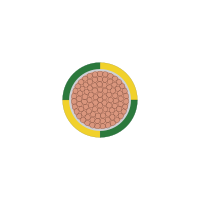
| Conductor Material | Class 5 Flexible Tinned Annealed Copper |
| Cross-Sectional Area | 10.0 mm² |
| Insulation Material | Cross-linked Polyolefin (XLPO), Halogen-Free |
| Outer Sheath Material | UV & Weather Resistant XLPO |
| Rated DC Voltage | 1.5kV DC (1500V DC Vector Rating) |
| Max Conductor Resistance (20°C) | 1.95 $\Omega$/km |
| Temperature Range | -40°C to +90°C (Max Conductor Temp: 120°C for 20k hrs) |
| Bending Radius | Fixed: 4× Outer Diameter | Flexible: 6× Outer Diameter |
| Certifications & Compliance | TÜV EN 50618 / IEC 62930 / RoHS Compliant |
3. Pure Copper vs. Tinned Copper vs. CCA: What’s the Difference?
Conductor selection directly dictates cable lifespan. In solar applications, moisture ingress, thermal cycling, and oxidation are constant factors.
+-------------------------------------------------------------------------+
|                              CONDUCTOR TYPES                            |
+------------------------------------+------------------------------------+
| Tinned Copper (Industry Standard)  | Pure Bare Copper (Indoor Only)     |
| - Tin coating stops oxidation      | - Oxidizes when exposed to moisture|
| - Superior crimp integrity         | - Higher resistance growth over time|
| - Excellent for high humidity      | - Unsuited for rooftop conduit     |
+------------------------------------+------------------------------------+
- Tinned Annealed Copper: Individual micro-strands of pure copper are coated with a micro-thin layer of tin. Tin acts as a barrier, preventing oxygen and moisture from reacting with the copper to create copper oxide (which is non-conductive and increases electrical resistance).
- Copper-Clad Aluminium (CCA): Never use CCA for DC solar wiring. CCA features an aluminium core coated with a thin layer of copper. CCA has 38% higher electrical resistance than copper, degrades under outdoor vibration, and introduces severe fire risks on 1000V+ DC strings.
4. Insulation Quality: XLPO vs. Standard PVC
Standard electrical cables designed for residential AC distribution typically use Polyvinyl Chloride (PVC) insulation. Installing PVC wire on a solar array is a major point of failure in outdoor systems.
Why XLPO Insulation is Required:
- Thermal Endurance: Electron-beam cross-linked polyolefin (XLPO) does not melt or drip when subjected to extreme short-circuit heat spikes up to 250°C. PVC degrades and melts at temperatures above 70°C.
- UV and Weather Resistance: Outdoor rooftop wiring faces direct sunlight exposure for 25+ years. XLPO sheathing is engineered to resist UV degradation and ozone cracking.
- Halogen-Free Safety (LSZH): Low Smoke Zero Halogen insulation ensures that if a thermal event occurs, the cable does not emit toxic chlorine gas or corrosive acid fumes.
5. Field Installation: Bending Radius, Crimping & Conduit Routing
Installing 10mm² single-core flexible cable requires specific field practices to preserve electrical safety and mechanical integrity:
- Crimping MC4 Connectors: Always use a dedicated ratcheting solar crimping tool calibrated for 10mm² (8 AWG) pins. Open-barrel pliers or basic electrical crimpers create loose contacts, leading to high-resistance hotspots and thermal breakdown of MC4 housings.
- Minimum Bending Radius: Maintain a bending radius of at least 4 to 6 times the outer cable diameter. Over-bending fractures internal conductor strands and stresses the double-layer insulation jacket.
- Conduit Protection: Despite UV-resistant XLPO jackets, long exposed runs should be enclosed in corrugated outdoor conduit or heavy-duty cable trays to protect against mechanical strain and animal damage.
Frequently Asked Questions (FAQs)
What is the difference between 6mm² and 10mm² solar cable?
A 10mm² cable has a larger cross-sectional area than a 6mm² cable, allowing it to safely carry higher amperage (up to 98A vs ~70A) with significantly lower voltage drop over long distances. 10mm² is typically used for long runs or parallel string arrays.
Can I use single-core 10mm² DC cable for AC connections?
While the conductor can carry AC current, solar DC cable features specialized XLPO double insulation rated for high DC voltage (1500V). Standard AC cables are less expensive for indoor AC distribution, while DC solar cables are designed for outdoor rooftop conditions.
Is tinned copper better than bare copper for solar wiring?
Yes. Tinned copper prevents oxidation caused by air and moisture ingress. Un-tinned copper forms a layer of copper oxide over time at connection points, which increases electrical resistance and heat buildup.
Why is single-core cable preferred over multi-core cable for solar DC arrays?
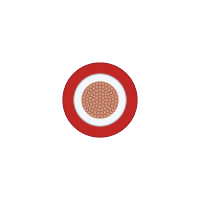
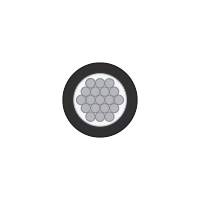
Single-core cables offer better thermal management, higher mechanical flexibility, and easier routing inside tight combiner boxes and solar isolated switches. They also allow for cleaner separation of positive (red) and negative (black) runs to minimize short-circuit risks.
About the Author

Ahmad Raza Ali is a Digital Marketing Manager and technical content strategist specializing in renewable energy infrastructure and industrial cable specifications. With a deep focus on search engine optimization and E-E-A-T principles, Ahmad bridges the gap between complex electrical engineering standards (IEC/BS) and practical consumer solar applications. He has been working with LifeCables.com; its sister company TaxAccountant.pk and MechaFuze an SEO Executive for long. He is a BBA cont. undergraduate as well with majors in marketing studying at SZABIST ISB.
