


6 mm² Single Core DC Solar Cable: Best Technical Guide & Specs


Why 6 mm² Single Core DC Solar Cable is the Workhorse of Reliable PV Systems
Installing a solar power system involves balancing inverter ratings, panel efficiency, and mounting angles. However, the cabling connecting these components often receives less attention. Direct Current (DC) cables carry high voltage and continuous current under extreme environmental conditions, making proper selection essential.
Among available wire gauges, the 6 mm² single core DC solar flexible premium copper cable serves as the standard industry baseline for residential and commercial rooftop solar installations. Selecting high-grade, multi-stranded tinned copper cabling prevents hidden voltage losses, localized heating, and insulation breakdown over time.
What Makes a True 6 mm² Single Core DC Solar Cable (Solar-Grade) Different?
Standard electrical wiring designed for indoor AC circuits (such as standard building wire or flex cord) fails rapidly when exposed to rooftop solar conditions. DC solar wiring requires specialized engineering to withstand UV radiation, extreme temperature fluctuations, mechanical stress, and continuous direct current flow.
Tinned Electrolytic Copper vs. Bare Copper
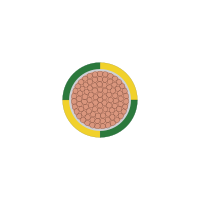
At the core of a high-performance 6 mm² DC cable is Class 5 fine-stranded electrolytic copper. Unlike solid core wire, fine stranding gives the cable high flexibility, making long runs through conduit and tight bends behind panel frames straightforward without snapping internal conductors.
Furthermore, solar cables utilize tinned copper strands. Coating each individual copper strand with a thin layer of tin prevents copper oxidation—a primary cause of increased resistance and terminal overheating in damp or humid environments.
Cross-Linked Polyolefin (XLPO) Double Insulation
Standard PVC insulation deteriorates under constant ultraviolet exposure and fails under high temperatures. Dedicated solar cables feature a dual-layer jacket system made from halogen-free, cross-linked polyolefin (XLPO) or cross-linked polyethylene (XLPE):
- Inner Insulation Layer: Delivers high thermal stability and dielectric strength to isolate high DC voltages (up to 1000V or 1500V DC).
- Outer Sheath: Provides resistance against UV rays, ozone, abrasion, moisture, and chemical exposure.
Technical Specifications & Performance Benchmarks
When evaluating 6 mm² single-core solar cables, review the manufacturer’s technical datasheet for compliance with international safety standards like EN 50618 (H1Z2Z2-K) or TÜV 2 PfG 1169:
| Technical Parameter | Standard Specification (6 mm² Solar Cable) |
| Conductor Material | Flexible Tinned Copper (Class 5 fine stranded) |
| Nominal Cross-Section | 6.0 mm² |
| Insulation & Outer Sheath | Halogen-Free, Flame Retardant XLPO / XLPE |
| Rated Voltage | 1.0 kV AC / 1.5 kV DC |
| Current Carrying Capacity | ~55A to 70A (ambient temp dependent) |
| Operating Temperature Range | -40°C to +90°C (Max conductor temp 120°C for 20,000h) |
| UV & Ozone Resistance | EN 50396 / EN 60811-503 compliant |
| Expected Service Life | Minimum 25 years |
Engineering Value: Minimizing Voltage Drop & Thermal Degradation
Solar panels produce low-voltage, high-current DC output before the inverter converts it to AC. Every milliohm of resistance along the DC string converted into waste heat represents permanently lost solar energy generation.
Why 6 mm² Outperforms 4 mm² on Extended Runs
While 4 mm² solar cable is suitable for short string runs (under 15–20 meters) on small systems, 6 mm² cabling provides lower electrical resistance ($R \approx 3.39\ \Omega/\text{km}$ at 20°C compared to $\sim 4.95\ \Omega/\text{km}$ for 4 mm²).
Keeping voltage drop below 1% to 1.5% on the DC side ensures:
- Higher overall system efficiency and energy yield delivered to the inverter terminals.
- Lower operating temperatures along the cable run, extending insulation lifespan.
- Flexibility to expand panel string lengths without recabling the main DC run.
Field Reliability & Installation Best Practices
Installing solar cabling requires adherence to electrical codes and field best practices:
- Use Purpose-Built MC4 Connectors: Crimp 6 mm² solar cable using specialized ratchet crimping tools designed for solar pins. Standard pliers or loose crimps introduce high resistance points that cause arcing or melted connectors.
- Respect Minimum Bend Radii: Avoid severe bends immediately exiting the connector housing or junction box. Maintain a bend radius of at least 4 to 5 times the cable’s outer diameter to prevent jacket stress.
- Avoid Standing Water: While solar cables are weather-resistant and moisture-tolerant, continuous submersion in stagnant water in un-drained conduits accelerates jacket breakdown over decades.
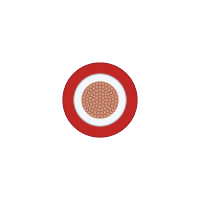
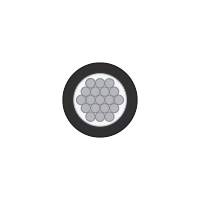
- Color-Code Separations: Always run distinct color jackets—typically red for positive DC lines and black for negative DC lines—to simplify testing, commissioning, and future maintenance.
Frequently Asked Questions
Can I use standard AC electrical wire for my solar DC connections?
No. Standard AC building wire lacks UV-stabilized double insulation and tinned conductors. Exposing standard wire to roof environments leads to insulation cracking, water ingress, short circuits, and severe fire risks within 2 to 3 years.
Why is single core cable preferred over multi-core cable for solar arrays?
Single core cables allow installers to route positive and negative lines along separate paths, minimizing the risk of intra-cable short circuits. They are also significantly easier to strip, bend, and terminate into individual MC4 solar connectors.
What is the maximum current a 6 mm² DC solar cable can handle?
Under standard test conditions at 60°C ambient air temperature, a quality 6 mm² DC solar cable handles continuous current between 55A and 70A. However, local electrical codes recommend derating maximum capacity based on ambient temperatures and conduit packing density.
How do I verify if a 6 mm² solar cable is genuine tinned copper?
Scrape a small section of a conductor strand with a sharp blade. The outer silver layer should reveal bright reddish copper underneath. If the wire remains silver throughout or feels brittle, it is likely tinned Aluminum (CCAM), which carries higher resistance and lower current limits.
About the Author

Ahmad Raza Ali is a Digital Marketing Manager and technical content strategist specializing in renewable energy infrastructure and industrial cable specifications. With a deep focus on search engine optimization and E-E-A-T principles, Ahmad bridges the gap between complex electrical engineering standards (IEC/BS) and practical consumer solar applications. He has been working with LifeCables.com; its sister company TaxAccountant.pk and MechaFuze an SEO Executive for long. He is a BBA cont. undergraduate as well with majors in marketing studying at SZABIST ISB.