


16 mm² Single Core DC Solar Flexible Cable: Sizing & Technicalities – Best Latest Guide


Why 16 mm² Single Core DC Solar Flexible Cable is the Sweet Spot for High-Current Systems
When designing or upgrading a solar power system, most installer conversations revolve around inverter capacities, panel wattages, and lithium battery chemistries. Yet, the physical cabling connecting these high-cost components quietly dictates system efficiency and long-term safety.
Among the various gauge options on the market, 16 mm² single core DC solar flexible cable sits in a crucial spot. It bridges the gap between light string wiring (like standard 4 mm² or 6 mm² solar cables) and heavy-duty battery interconnect cables (such as 25 mm² or 35 mm²).
If you are managing high-current DC runs, long panel array distances, or connecting a 48V battery bank to a 5kW–8kW inverter, choosing the right cross-sectional area prevents excessive voltage drop, nuisance trips, and dangerous overheating.
Technical Profile: Understanding 16 mm² DC Solar Flexible Cable
A 16 mm² single core DC flexible solar cable is engineered specifically for direct current (DC) transmission under harsh environmental conditions. Unlike standard building wire or stranded AC flex, solar-rated cables undergo specialized manufacturing processes to withstand thermal, chemical, and physical stress.
1. Multi-Stranded Tinned Copper Conductors
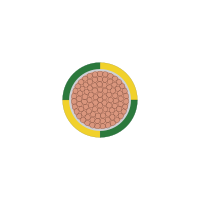
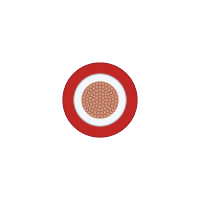
The core consists of fine, class 5 flexible tinned copper strands. Tinned copper is essential in outdoor DC systems because copper naturally oxidizes when exposed to moisture and air. Oxidation creates copper oxide, an insulating layer that degrades electrical conductivity at terminal joints and MC4 connectors. The thin layer of tin prevents corrosion, ensuring lower contact resistance over decades of service.
2. Dual-Layer Cross-Linked Insulation (XLPO)
Standard PVC insulation deteriorates rapidly under outdoor sunlight and high DC voltage stress. A quality 16 mm² DC solar cable features dual-layer insulation made from Cross-Linked Polyolefin (XLPO) or halogen-free cross-linked compound (e.g., EN 50618 / H1Z2Z2-K standards).
- Inner layer: Electrical insulation capable of handling working voltages up to 1500V DC.
- Outer sheath: Mechanical protection resistant to UV radiation, ozone, oil, and flame retardancy.
3. High Temperature Rating
Solar roofs easily reach temperatures exceeding 60°C (140°F) in peak summer. A rated 16 mm² solar flex wire maintains operational performance in ambient temperatures from -40°C up to +90°C, with a maximum conductor temperature tolerance of 120°C for up to 20,000 hours.
Where Should You Use 16 mm² Solar Cables?
Using a 16 mm² cable everywhere in a residential installation is neither cost-effective nor practical due to connector sizing. However, in specific sections of your system, it is mandatory to prevent performance bottlenecks.
1. Inverter to Battery Connections (48V Systems)
For a typical 5 kW or 8 kW off-grid or hybrid inverter operating on a 48V nominal battery bank, full-load DC currents routinely reach 100A to 150A. Standard 6 mm² wire will overheat and drop significant voltage under these loads. A 16 mm² flexible cable provides the current-carrying capacity needed for short runs (under 2 meters) between the battery breaker and inverter terminal blocks.
2. High-Amperage Solar Combiner Boxes
When combining multiple parallel strings of solar panels before entering the charge controller, the cumulative amperage increases. While individual strings run comfortably on 4 mm² or 6 mm² cables, the main DC trunk line coming out of a combiner box often handles 30A to 60A over longer distances. Using a 16 mm² cable minimizes line losses across the longer run from the roof to the inverter room.
3. Marine, RV, and Commercial Off-Grid Systems
Mobile and off-grid applications demand high flexibility because vehicles and boats generate continuous vibration. Class 5 flexible stranded copper prevents conductor fatigue and terminal clamping failures that rigid solid-core cables suffer over time.
16 mm² Cable Specifications at a Glance
| Feature / Specification | Standard Value / Metric |
| Conductor Cross-Section | 16 mm² |
| Conductor Material | Flexible Tinned Copper (Class 5) |
| Nominal Voltage Rating | 1.0/1.0 kV AC | 1.5/1.5 kV DC |
| Current Ampacity (In Air @ 60°C) | ~98A – 135A (depending on layout) |
| Insulation Material | Electron-beam cross-linked halogen-free polyolefin |
| Operating Temperature Range | -40°C to +90°C (Max conductor temp 120°C) |
| UV & Ozone Resistance | EN 50396 / HD 605/A1 |
Mitigating Voltage Drop: Why Cross-Sectional Area Matters
Voltage drop is the enemy of solar efficiency. In DC electrical systems, low voltage combined with high current means every milliohm of conductor resistance results in lost power dissipated as heat:
$$P_{\text{loss}} = I^2 \cdot R$$
When DC voltage drops below acceptable limits (typically 1% to 2% target maximum loss), three problems occur:
- Lost Yield: Generated solar power turns into waste heat before reaching the inverter.
- False Battery Cut-Offs: The inverter measures voltage at its terminals. If a thin cable causes a 1.5V drop under heavy load, the inverter may trip low-voltage alarms prematurely while the battery still holds charge.
- Thermal Strain: Heated cables increase conductor resistance further, creating a negative loop of efficiency loss.
Upgrading a 10-meter DC line from 6 mm² to 16 mm² reduces conductor resistance by roughly 62%, cutting line losses down significantly during peak production hours.
Best Practices for Installing 16 mm² Single Core DC Solar Flexible Cable
1. Always Use Heavy-Duty Cable Lugs
Flexible stranded wire consists of hundreds of fine copper strands. Never insert bare fine strands directly into screw-clamp terminals without heavy-duty copper crimp lugs or suitable pin ferrules. Unprotected strands can break or spread under screw pressure, creating loose high-resistance hot spots.
2. Match Hydraulic Crimp Dies Precisely
Use a dedicated hydraulic crimping tool with 16 mm² dies. Under-crimping leaves air gaps inside the lug barrel leading to oxidation, while over-crimping deforms the copper and weakens mechanical pull-off strength.
3. Maintain Proper Bend Radii
Although rated as “flexible,” 16 mm² solar cable has a thick dual-sheath insulation layer. Adhere to a minimum bending radius of 4 to 6 times the outer cable diameter to avoid stressing the inner insulation wall or causing micro-cracks in the sheath over time.
Frequently Asked Questions (FAQs)
What is the maximum current capacity (ampacity) of 16 mm² solar DC cable?
In free air at an ambient temperature of 60°C, a high-quality 16 mm² DC solar cable is rated for approximately 98A to 135A, depending on installation grouping and international manufacturing standards (such as EN 50618 or IEC 62930).
Can I use standard AC battery or flex wire for solar DC installations?
It is not recommended. Standard AC PVC-insulated cables lack UV stabilization, ozone protection, and electron-beam cross-linked insulation. Outdoor exposure causes standard PVC to crack and degrade within 2 to 5 years, posing direct short-circuit and fire risks under high DC voltage.
What is the difference between single core and multi-core solar cables?
Single core solar cables are preferred for long outdoor runs and array wiring because they dissipate heat better, are easier to strip and terminate with waterproof connectors, and allow separate red/black routing to eliminate single-point short circuits between positive and negative conductors.
Do I need MC4 connectors for 16 mm² cables?
Standard MC4 connectors accommodate cable cross-sections up to 6 mm². For 16 mm² cables, you must use specialized high-current DC connectors or MC4 EVO 2 / Heavy-Duty 10-16mm² terminals rated for larger wire gauges and higher amperages.
About the Author

Ahmad Raza Ali is a Digital Marketing Manager and technical content strategist specializing in renewable energy infrastructure and industrial cable specifications. With a deep focus on search engine optimization and E-E-A-T principles, Ahmad bridges the gap between complex electrical engineering standards (IEC/BS) and practical consumer solar applications. He has been working with LifeCables.com; its sister company TaxAccountant.pk and MechaFuze an SEO Executive for long. He is a BBA cont. undergraduate as well with majors in marketing studying at SZABIST ISB.
