


4 mm² Single Core Flexible DC Solar Cable Guide: Best Article for Specs & Uses


Understanding the 4 mm² Single Core Flexible DC Solar Premium Copper Cable: A Complete Field Guide
Solar energy systems are only as reliable as the wiring that connects them. While solar panels, inverters, and battery banks often steal the spotlight, the direct current (DC) cabling running between these components does the quiet, high-stakes work of transmitting generated power with minimal energy loss.
Among the various wiring specifications available today, the 4 mm² single-core flexible DC solar premium copper cable has emerged as the industry standard for residential and light commercial solar photovoltaic (PV) installations.
Why Wire Selection Dictates Solar Efficiency and Safety
In a solar PV array, power flows continuously under variable outdoor conditions. DC power behaves differently than standard alternating current (AC) household wiring: it operates at lower voltages and higher currents for long continuous stretches, making it far more vulnerable to voltage drop, heat buildup, and power loss if the conductor size or material is inadequate.
Using sub-standard or undersized cabling in a DC circuit creates two major risks:
- Linear Efficiency Drops: Excessive resistance converts precious kilowatt-hours into wasted heat before they ever reach your inverter.
- Thermal Stress & Fire Hazards: Overheated cabling can degrade insulation, cause short circuits, or present severe electrical fire risks over time.
This is precisely why choosing an engineered, cross-linked, high-purity copper solar cable is a core requirement—not an optional upgrade.
Key Technical Features of 4 mm² Single Core Flexible DC Solar
Understanding what goes into a high-grade DC solar cable helps explain why it performs consistently over a 25-plus-year lifespan.
1. High-Purity Tinned Annealed Copper Conductors
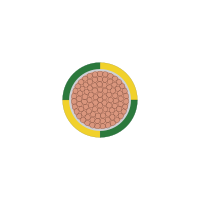
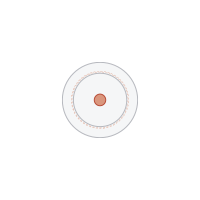
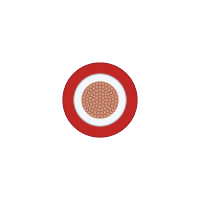
The core of a premium solar cable uses finely stranded, electrolytic-grade annealed copper.
- Tinned Protection: Each copper strand is coated with a thin layer of tin. Tinned copper prevents atmospheric corrosion, oxidation, and chemical degradation—especially crucial in humid, coastal, or industrially polluted environments.
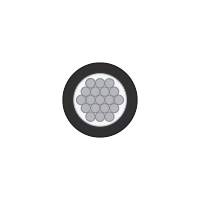
- Flexible Stranding: Rather than a rigid solid-core wire, multiple fine strands are wound tightly together. This multi-strand construction yields high flexibility, making tight bends inside conduit, trunking, or roof entry boxes easy without stressing the metal.
2. Dual-Layer Cross-Linked Insulation (XLPO/XLEP)
Standard PVC insulation deteriorates rapidly under constant ultraviolet (UV) radiation and outdoor thermal cycling. Premium solar cables utilize Electron-Beam Cross-Linked Polyolefin (XLPO) or similar halogen-free insulation materials for both the inner core insulation and outer sheath.
- UV & Ozone Resistance: Designed to endure decades of direct sunlight without cracking, chalking, or hardening.
- Flame Retardant & Halogen-Free: In the event of an external fire, cross-linked halogen-free sheathing emits minimal smoke and zero toxic corrosive gases.
- Extreme Temperature Tolerance: Maintains structural and electrical integrity in operational ambient temperatures ranging from -40°C up to +90°C (with maximum conductor temperatures reaching +120°C).
3. Voltage Rating & Mechanical Durability
Engineered explicitly for modern high-voltage DC string arrays, these cables carry a nominal operational rating of 1.0 kV to 1.5 kV DC. The tough outer jacket resists abrasion, impact, rodent activity, and direct exposure to moisture or chemicals.
Technical Specifications Matrix
| Feature / Metric | Specification Detail |
| Conductor Material | High-purity Tinned Annealed Copper (Class 5 fine-stranded) |
| Cross-Sectional Area | 4.0 mm² |
| Insulation & Outer Sheath | Electron-beam cross-linked halogen-free compound (XLPO) |
| Rated Voltage | 1.0 kV AC / 1.5 kV DC |
| Temperature Range | -40°C to +90°C ambient (+120°C max conductor temp) |
| Bending Radius | ~4 to 5 times overall cable diameter |
| Expected Service Life | 25+ years under direct outdoor exposure |
| Standard Compliance | EN 50618 / IEC 62930 / TÜV Approved |
Where and When to Use 4 mm² vs. 6 mm² Solar Cables
Selecting between a 4 mm² cable and a larger 6 mm² conductor depends on three main factors: current load (amperage), distance (run length), and allowable voltage drop.
Ideal Applications for 4 mm² Solar Cables
- String Inverter Connections: Standard residential solar panel strings where string current typically stays between 10A and 18A.
- Short to Medium Distance Runs: Distances between the roof array and the combiner box or inverter that are under 15 to 20 meters (49 to 65 feet).
- Microinverter & Optimizer Jumpers: Interconnecting individual panel leads to roof-mounted microinverters or DC optimizers.
When You Should Step Up to 6 mm²
- Long Cable Runs: When the distance between your PV panels and inverter exceeds 20 to 25 meters, stepping up to 6 mm² keeps the overall voltage drop strictly below the recommended 1% to 2% threshold.
- High-Current Bifacial Panels: Systems running parallel strings or high-amp commercial panels delivering 20A or more continuously over single cable runs.
Installation Best Practices for Long-Term Safety
Even the highest-quality 4 mm² cable will fail prematurely if improperly installed. Here are key field-tested practices to ensure safety and system longevity:
- Use Dedicated MC4 Connectors: Always crimp cables using certified MC4-compatible solar connectors and dedicated ratchet crimping tools. Avoid hand-soldering or casual twist-and-tape joints.
- Respect the Minimum Bend Radius: Avoid sharp 90-degree kinks immediately exiting conduit or panel frames. Maintain a smooth curve (at least 4 to 5 times the cable’s outer diameter).
- Secure with UV-Rated Cable Ties: Use stainless steel clips or outdoor UV-stabilized nylon cable ties every 30 to 50 cm along panel frames to prevent wind-induced chafing.
- Avoid Permanent Water Immersion: While solar cables are weather-resistant and moisture-tolerant, they should not sit permanently submerged in standing water inside low conduit dips or roof puddles.
Frequently Asked Questions (FAQs)
Can I use standard household AC electrical wire for my solar DC system?
No. Standard AC electrical wires (such as building wire or standard PVC flex) lack UV-stabilized sheathing, cross-linked insulation, and proper tinned corrosion resistance. Direct exposure to sunlight and thermal cycling will crack AC cable insulation within months, causing earth faults and fire hazards.
Is 4 mm² solar cable suitable for 12V or 24V off-grid battery systems?
Yes, but only for short cable runs or low-wattage panels. Low-voltage systems (like 12V) carry much higher amperage for the same wattage compared to high-voltage grid-tied systems. Always check your total amperage and run length using a voltage drop calculator before installation.
What is the current-carrying capacity (ampacity) of a 4 mm² solar cable?
A standard 4 mm² tinned copper solar cable typically has a continuous current rating of around 55 Amps to 60 Amps in free air at 60°C ambient. However, for system safety and temperature derating, string design usually accounts for lower continuous operational limits.
Why is tinned copper preferred over plain red copper for solar cables?
Solar arrays operate outdoors for decades. Oxygen and atmospheric moisture oxidize plain copper over time, forming a non-conductive layer of copper oxide at connection joints. Tinned coating protects the underlying copper from oxidation and maintains low contact resistance at terminals.
About the Author

Ahmad Raza Ali is a Digital Marketing Manager and technical content strategist specializing in renewable energy infrastructure and industrial cable specifications. With a deep focus on search engine optimization and E-E-A-T principles, Ahmad bridges the gap between complex electrical engineering standards (IEC/BS) and practical consumer solar applications. He has been working with LifeCables.com; its sister company TaxAccountant.pk and MechaFuze an SEO Executive for long. He is a BBA cont. undergraduate as well with majors in marketing studying at SZABIST ISB.
