





1.5 mm² (70/0076″) Wire Guide: Single vs 2-Core Specs & Load – Best Latest Guide


Choosing the right wire size for home electrical work or light industrial installations isn’t just a technical decision—it directly impacts safety, long-term efficiency, and project cost. Among the most widely specified conductors in modern electrical work is the 1.5 mm² wire, commonly referred to in traditional imperial measurements as 70/0076″. Professionally known as 1.5 mm² (70/0076″) wire.
When contractors or homeowners step into an electrical hardware shop, the debate usually centers around whether to buy Single Core or 2-Core twin cables. While both use the same underlying copper conductor cross-section, their applications, insulation profiles, and installation methods differ significantly.
Below is an practical guide breaking down the technical specifications, real-world load capacities, key differences, and selection criteria for 1.5 mm² (70/0076″) wires.
What Does 1.5 mm² or 70/0076″ Actually Mean?
Understanding electrical cable nomenclature prevents buying undersized or substandard wiring.
- 1.5 mm² (Metric Rating): Refers to the total cross-sectional area of the copper conductor inside the insulation jacket. Under International Electrotechnical Commission (IEC) standards, metric sizing measures exact cross-sectional area.
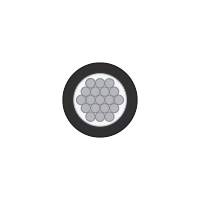
- 70/0076″ (Imperial Rating): Represents the construction format. It means the conductor consists of 70 fine strands of pure copper wire, with each strand having a thickness of 0.0076 inches.
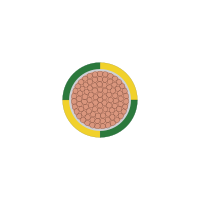
Combining 70 flexible copper strands yields an effective cross-sectional area roughly equivalent to 1.5 mm². This multi-strand construction gives 70/0076″ cables high flexibility compared to rigid single-strand (1/1.38 mm) conductors, making them far easier to pull through PVC conduit pipes or electrical trunking.
Technical Specifications & Current Load Capacity
Before selecting a cable, review its basic electrical limits. Operating a wire beyond its rated ampacity causes overheating, insulation breakdown, and fire hazards.
| Technical Parameter | 1.5 mm² / (70/0076″) Specification |
| Conductor Material | High-grade Annealed Copper (99.9% Pure) |
| Current Carrying Capacity | 10 Amps to 15 Amps (depending on installation method) |
| Wattage Capacity (at 220V-240V) | ~2,200W to 3,300W maximum continuous load |
| Insulation Type | PVC (Polyvinyl Chloride) or Flame Retardant (FR-PVC) |
| Voltage Rating | 300V / 500V or 450V / 750V |
| Standard Compliance | BS 6004 / IEC 60227 |
Pro Tip: In conduit installations with multiple loaded wires bundled together, thermal dissipation decreases. Always de-rate your wire capacity by 20% to safely account for ambient heat.
Single Core vs. 2-Core (Twin) Cables: Core Differences
The primary distinction between Single Core and 2-Core (70/0076″) cables lies in their physical construction and how they are routed.
1. Single Core 1.5 mm² (70/0076″)
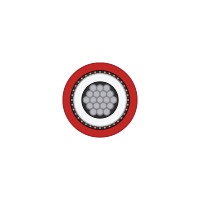
A single-core wire consists of 70 copper strands encased inside a single layer of PVC insulation (typically color-coded red, black, blue, or green/yellow for phase, neutral, and earth).
- Where it’s used: Internal conduit wiring in residential homes, commercial buildings, control panels, and distribution boards.
- Key advantage: Can be pulled independently through PVC conduits alongside other circuits. If a single line damages, replacing just one wire is easy.
- Requirement: Must always be housed inside conduit pipes, trunking, or ducts for protection.
2. 2-Core (Twin Sheathed) 1.5 mm² (70/0076″)
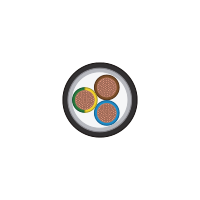
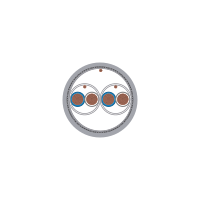
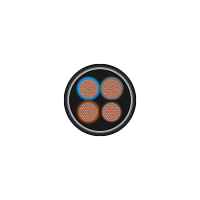
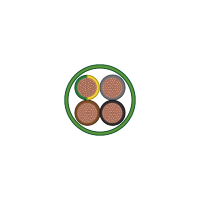
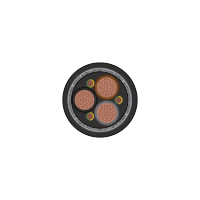
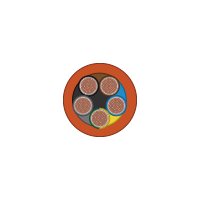
A 2-Core cable contains two individually insulated 1.5 mm² conductors (typically Live and Neutral) bundled together inside an extra protective outer PVC sheath.
- Where it’s used: Surface wiring, exposed extensions, hanging pendant lights, small household appliances, and temporary power runs.
- Key advantage: Dual-layer insulation provides high mechanical protection. It can be clipped directly onto walls without conduit.
- Limitation: Harder to fish through narrow, curved conduits due to its thicker, oval or round profile.
Where Should You Use 1.5 mm² (70/0076″) Cables?
A 1.5 mm² wire is the standard workhorse for light-duty domestic power circuits. Recommended real-world applications include:
- Indoor & Outdoor Lighting Circuits: LED panels, ceiling fans, chandeliers, bracket lights, and spotlight tracks.
- Low-Power Appliances: Table fans, exhaust fans, Wi-Fi routers, TV setups, and computer workstations.
- Control & Signal Wiring: Connecting switches to light fixtures, doorbell wiring, and relay switches in automation setups.
- Uninterruptible Power Supply (UPS) Lines: Dedicated low-voltage return circuits for lighting backup during power outages.
What NOT to Wire with 1.5 mm²:
Do not use 1.5 mm² (70/0076″) for heavy inductive loads or high-wattage heating appliances. Avoid using it for:
- Air conditioners (1.0 Ton to 2.0 Ton) → Use 4.0 mm² or 6.0 mm²
- Electric water heaters & geysers → Use 2.5 mm² or 4.0 mm²
- Kitchen power sockets (Microwaves, Irons, Fryers) → Use 2.5 mm²
- Main sub-distribution feeds → Use 6.0 mm² to 10.0 mm²
3 Practical Tips to Identify Genuine Pure Copper Wire
Substandard cables with copper-clad aluminum (CCA) or recycled copper lead to high electrical resistance, voltage drops, and potential electrical fires. Here is how field technicians verify quality:
- Check the Strand Count: Strip the insulation and count the individual copper filaments. A true 70/0076″ cable will have exactly 70 fine strands.
- Scrape Test: Scrape the surface of a copper strand with a knife. If it turns silvery or white beneath, it is Copper-Clad Aluminum (CCA). Pure copper remains bright orange-red throughout.
- Check Resistance & Weight: Pure copper is noticeably heavier than aluminum. Authentic 1.5 mm² copper coil (typically 90 meters or 100 yards) weighs significantly more than cheap imitation coils.
Frequently Asked Questions (FAQs)
Q1: How many amperes can a 1.5 mm² (70/0076″) wire safely handle?
A 1.5 mm² copper cable handles between 10A and 15A under normal room temperatures. For continuous loads, keep the current under 12A (around 2,500 Watts at 230V) to prevent thermal buildup.
Q2: Can I use 1.5 mm² wire for standard 13A wall socket points?
It is recommended to use 2.5 mm² (7/029″ or 7/036″) for general power sockets. While a 1.5 mm² wire can run low-power devices, plugging in a heavy appliance (like a vacuum or space heater) into a socket wired with 1.5 mm² could overheat the circuit.
Q3: What is the difference between single-strand and multi-strand 1.5 mm² wire?
Single-strand wires use one solid copper conductor (1/1.38 mm), making them rigid and harder to bend. Multi-strand (70/0076″) wires use 70 flexible fine strands, making them far easier to pull around sharp conduit bends without snapping.
Q4: Is 70/0076″ identical to 1.5 mm²?
Yes, for all practical installation purposes. 70/0076″ is the older imperial sizing format (70 strands of 0.0076-inch wire), which yields approximately 1.5 mm² of copper cross-section under metric standards.
About the Author

Ahmad Raza Ali is a Digital Marketing Manager and technical content strategist specializing in renewable energy infrastructure and industrial cable specifications. With a deep focus on search engine optimization and E-E-A-T principles, Ahmad bridges the gap between complex electrical engineering standards (IEC/BS) and practical consumer solar applications. He has been working with LifeCables.com; its sister company TaxAccountant.pk and MechaFuze an SEO Executive for long. He is a BBA cont. undergraduate as well with majors in marketing studying at SZABIST ISB.