


Best 4mm DC Solar Wire for 5kW Solar System: Expert Selection


Choosing the Best 4mm DC Solar Wire for 5kW Solar System: A Practical Guide
When investing in a 5kW solar system, it’s easy to get caught up in the big-ticket items. You’ll spend hours researching panel efficiencies, comparing string versus micro-inverters, and calculating your payback period. However, there is a silent, crucial component that connects this entire investment together: the DC solar cable.
A single weak link in your wiring can quietly drain your system’s efficiency, or worse, create a serious fire hazard. If you are setting up a standard 5kW residential solar installation, you have likely been told that a 4mm² DC solar wire is the industry sweet spot. But with dozens of brands, counterfeit products, and confusing technical jargon out there, how do you pick the right one?
Let’s skip the marketing fluff and look at the actual, boots-on-the-ground engineering reality of what makes a 4mm DC solar wire the “best” choice for your 5kW setup.
Why Wire Size Matters: The 5kW Math Explained Simply
Before looking at specific brands or features, let’s establish why a 4mm² (roughly 12 AWG) wire is typically recommended for a 5kW system, and where its limits lie.
A standard 5kW grid-tied solar system usually consists of 10 to 13 panels, typically broken down into one or two strings.
- Current (Amperage): Modern high-wattage solar panels (450W to 550W+) generally push between 11 to 14 Amperes of short-circuit current ($I_{sc}$).
- The 4mm² Capacity: A high-quality 4mm² copper solar wire is safely rated to handle up to 40 to 55 Amperes in open air, depending on the temperature.
On paper, 4mm² is more than enough to handle the current of a single string. However, solar design isn’t just about not melting the wires; it’s about minimizing voltage drop.
The Voltage Drop Rule of Thumb
In solar engineering, you want to keep your DC voltage drop under 1% to 2%. If your total cable run from the roof to the inverter is under 30 meters (approx. 100 feet), a 4mm² wire will perform beautifully, keeping your power losses negligible. However, if your inverter is located far away in a basement or a distant garage, and your cable run exceeds 35 meters, you should step up to a 6mm² wire for the main home run to avoid losing precious kilowatt-hours to pure resistance.
The Anatomy of the “Best” DC Solar Wire
Not all copper strands are created equal. When sourcing wire that will sit on a scorching roof for the next 25 years, you must look for three non-negotiable manufacturing standards.
1. Tinned Copper Core (Class 5 Flexibility)
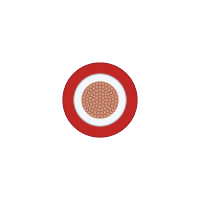
Never use standard electrical wire or bare copper for solar installations. The best DC solar wires use Class 5 flexible, tinned copper conductors. Tinning the copper strands protects them from oxidation and corrosion, which accelerates rapidly in humid, outdoor environments.
2. XLPO Double Insulation
The jacket material matters immensely. Look for cables insulated with Cross-linked Polyolefin (XLPO). High-quality wires feature dual-layer insulation (an inner jacket and an outer sheath). XLPO is highly resistant to extreme heat, UV radiation, and ozone. It doesn’t crack or become brittle after a decade of exposure to intense sunlight.
3. Certification Stamps (EN 50618 / TÜV)
The easiest way to spot a premium solar wire from a dangerous knock-off is the printing on the jacket. The absolute gold standard for solar cables is the EN 50618 European standard (often bearing a TÜV Rheinland approval mark). This certification guarantees that the wire is rated for 1500V DC, is flame retardant, halogen-free, and proven to last a lifetime.
Top Characteristics to Look For in Leading Solar Wire Brands
While specific brand availability varies by region, the top-tier global manufacturers all share distinct engineering hallmarks. When reviewing options from reputable names like KBE Berlin, Prysmian, Lapp Group, or top-tier certified regional manufacturers, look for these specific indicators:
- Ultra-Wide Temperature Tolerances: The wire must be rated for ambient temperatures ranging from -40°C up to +90°C, with a maximum conductor temperature ceiling of 120°C. Rooftops under solar arrays act as thermal traps; cheap PVC insulation will degrade rapidly under these conditions.
- Mechanical Robustness: Premium wires offer excellent crush and impact resistance. This is critical during installation when wires might be pulled through sharp metal conduit or tightly clipped along aluminum solar rails.
- Water Resistance (AD8 Rating): Look for wires certified to withstand occasional submersion or high moisture levels. Water pooling in conduit can cause insulation breakdown over time if the wire isn’t explicitly rated for it.
How to Avoid Dangerous Counterfeits
The solar industry has seen a massive influx of sub-standard components. Here is how to protect your property and investment:
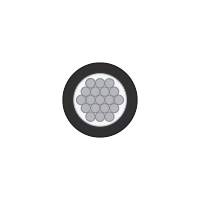
The Magnet Test: Some unscrupulous manufacturers sell Copper-Clad Aluminum (CCA) wires disguised as pure copper. Aluminum has a much higher resistance than copper, meaning a 4mm² CCA wire cannot safely carry the load of a 4mm² pure copper wire. Bring a small magnet when purchasing; pure copper and tin are non-magnetic. If the wire shows magnetic attraction, it contains an iron or steel core and is highly dangerous for solar applications.
Check the Legend: Legitimate manufacturers cleanly print their name, part number, certifications (e.g., H1Z2Z2-K), cross-sectional area (1x4mm²), and voltage rating right on the cable sheath every meter. If the printing is blurry, rubs off easily with a fingernail, or lacks certification markings, do not install it.
Practical Installation Tips for Peak Efficiency
Even the highest-grade cable will fail if poorly installed. Keep these core principles in mind during your 5kW setup:
- Conduit is Non-Negotiable: Even though XLPO insulation is UV-rated, always run your DC cables inside heavy-duty, UV-resistant PVC or metallic conduits where they travel down the side of your building. This protects them from weathering and rodents.
- Avoid Sharp Bends: Maintain a minimum bending radius of at least 4 to 5 times the outer diameter of the cable. Kinking the cable damages the internal tinned copper strands and stresses the insulation.
- Match Your Connectors: Always pair your 4mm² wire with high-quality, genuine MC4 connectors. Ensure you use a dedicated solar crimping tool rather than standard pliers to guarantee a completely airtight, moisture-proof connection.
Summary Checklist: Buying Your 4mm Solar Wire
Before you hand over your cash, verify your wire matches this exact specification profile:
| Feature | Required Specification |
| Conductor Material | Tinned Copper (Class 5 Flex) |
| Insulation Material | Dual-layer XLPO (Halogen-Free) |
| Voltage Rating | 1500V DC ($H1Z2Z2-K$) |
| Certification | EN 50618 / TÜV Approved |
| Max Run Length (5kW) | Up to 30–35 Meters |
Investing in premium 4mm² DC solar wire might add a tiny fraction to your overall system cost, but it pays massive dividends in peace of mind, safety, and long-term energy yields. Don’t let a cheap cable bottleneck your clean energy future.