




2.5 mm² (110/0076″) Wire Guide: Single Core vs 2-Core – Amazing Info


2.5 mm² (110/0076″) Wire Guide: Single Core vs. 2-Core Applications & Selection
When planning an electrical installation—whether wiring a new home or upgrading a commercial board—selecting the correct conductor gauge is critical. The 2.5 mm² wire, widely designated in traditional sizing systems as 110/0076″, serves as the backbone for standard power distribution circuits.
Using under-spec wiring can lead to voltage drops, dangerous overheating, and electrical fires. This guide breaks down the technical specifications, real-world application differences between single core and 2-core configurations, and practical installation standards.
Technical Specifications: What Does 110/0076″ Mean?
Electrical standards have shifted toward metric cross-sectional area designations ($\text{mm}^2$), but imperial strand notation remains widely used in local markets and legacy specifications.
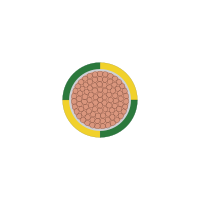
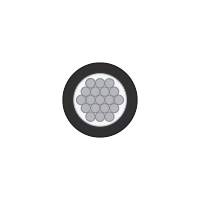
- 110 strands: The conductor consists of 110 individual micro-strands bundled together to provide flexibility and high current conductivity.
- 0.0076 inches: The precise diameter of each individual copper strand.
- 2.5 mm² cross-sectional area: The metric equivalent representing the total cross-sectional copper area.
Core Electrical Parameters
- Conductor Material: Plain Annealed Copper (Class 2 multi-strand or Class 5 flexible).
- Insulation: High-grade PVC (Polyvinyl Chloride) rated for standard 70°C operating conditions or XLPE for up to 90°C applications.
- Current Carrying Capacity (Ampacity): Approximately 18A to 25A, depending on installation conditions (conduit vs. free air) and ambient temperature.
- Voltage Rating: 300/500V or 450/750V.
Single Core vs. 2-Core Cables: Structural & Operational Differences
Choosing between single core and 2-core 2.5 mm² wiring depends primarily on conduit routing, space constraints, and physical protection requirements.
| Feature | 2.5 mm² Single Core (110/0076″) | 2.5 mm² 2-Core Twin Cable |
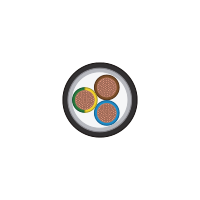
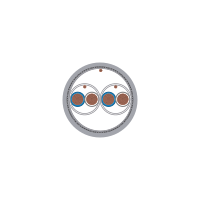
| Conductor Layout | One insulated conductor inside a PVC sheath | Two individually insulated conductors (Live & Neutral) inside a master outer sheath |
| Flexibility | Higher flexibility; easy to pull through complex conduit runs | Stiffer due to the secondary protective sheath |
| Primary Deployment | PVC conduit wiring, main distribution boards, panel wiring | Surface wiring, exposed extensions, portable heavy equipment |
| Physical Protection | Requires external conduit or trunking for safety | Built-in double insulation provides standalone mechanical protection |
| Installation Speed | Slower (requires pulling separate Live, Neutral, Earth lines) | Faster for single-run surface installations |
Key Real-World Applications
1. Power Plug Sockets & Ring Main Circuits
The 2.5 mm² (110/0076″) wire is the global standard for 15A and 16A power socket circuits. It comfortably handles household appliances including refrigerators, microwave ovens, water dispensers, and washing machines.
2. Inverter & UPS System Connection
When installing 1kVA to 3kVA residential inverter/UPS setups, 2.5 mm² wire is ideal for connecting the inverter output to the main breaker board without suffering noticeable voltage drop under load.
3. Dedicated Air Conditioning Feeders
For standard 1-ton to 1.5-ton split air conditioners, a dedicated 2.5 mm² circuit protected by a 16A or 20A Miniature Circuit Breaker (MCB) ensures stable voltage delivery during high startup currents.
Quality Inspection Checklist: How to Spot Premium Copper Wire
Counterfeit or sub-standard wiring with high iron or recycled alloy content leads to high internal resistance and excessive heat build-up. Always check the following before purchase:
- 100% Pure Oxygen-Free Copper: Strip a small section. Pure copper maintains a bright reddish-gold hue throughout. CCAM (Copper-Clad Aluminum) wires show a white/silver core when scraped or cut.
- Resistance Verification: High-quality 2.5 mm² copper should exhibit a conductor resistance of less than $7.41\ \Omega/\text{km}$ at 20°C.
- Insulation Flexibility & Thickness: Premium PVC insulation should flex smoothly without cracking or showing white stress marks when bent tightly.
Frequently Asked Questions (FAQs)
What is the maximum load a 2.5 mm² (110/0076″) wire can support?
Under standard indoor conduit installation conditions, a 2.5 mm² copper wire safely handles 18 to 22 Amperes. At a standard 230V supply, this translates to roughly 4,000 to 5,000 Watts total connected load.
Can I use 2.5 mm² wire for a 2-ton Split AC?
It is not recommended for long runs. While a 2.5 mm² wire can technically carry the running current of a 2-ton AC, the high startup surge (Inrush current) can cause voltage dips and insulation stress over time. Use a 4.0 mm² (7/.036″) wire for 2-ton units.
What is the difference between 7/.036″ and 110/0076″ wires?
Both wires offer roughly equivalent cross-sectional copper area (~2.5 mm²). However, 7/.036″ consists of 7 thicker solid strands (semi-rigid), whereas 110/0076″ features 110 fine strands (highly flexible). Multi-strand 110/0076″ is easier to pull through tight conduits and bends.
Is 2-core wire safe without an earth wire?
2-core cable contains only Live and Neutral conductors. It is safe for Class II double-insulated appliances (like plastic-cased tools or lamps). However, metal-bodied appliances and wall socket circuits strictly require a 3-core setup or a separate earthing wire for shock protection.
About the Author

Ahmad Raza Ali is a Digital Marketing Manager and technical content strategist specializing in renewable energy infrastructure and industrial cable specifications. With a deep focus on search engine optimization and E-E-A-T principles, Ahmad bridges the gap between complex electrical engineering standards (IEC/BS) and practical consumer solar applications. He has been working with LifeCables.com; its sister company TaxAccountant.pk and MechaFuze an SEO Executive for long. He is a BBA cont. undergraduate as well with majors in marketing studying at SZABIST ISB.