




Best guide on Tinned Copper Solar Wire 6mm vs 4mm Efficiency for Home Solar (2026)


Tinned Copper Solar Wire: 6mm vs 4mm Efficiency for Home Solar
Choosing the right components for your home solar installation can feel like navigating a maze of technical jargon. While most people spend hours researching solar panel efficiency and inverter warranties, they often overlook the literal lifeline of the entire system: the solar cables.
When installing a residential solar setup, the debate often boils down to two heavy hitters: 4mm² vs. 6mm² tinned copper solar wire. Is it always better to go bigger, or is the 4mm wire perfectly sufficient for your home?
Let’s break down the actual performance, efficiency, and real-world economics of these two cable sizes so you can make an informed decision for your project.
Why Tinned Copper? The Industry Gold Standard
Before comparing sizes, it is crucial to understand why tinned copper is the non-negotiable standard for high-quality photovoltaic (PV) systems.
Standard bare copper is an excellent electrical conductor, but it has a major vulnerability: oxygen and moisture. When exposed to the elements, copper oxidizes, turning green and losing its conductivity. Solar wires operate under extreme conditions—scorching summer heat, freezing winters, and high UV exposure.
[Bare Copper] + [Moisture/Oxygen] ---> Oxidation (High Resistance)
[Tinned Copper] + [Tin Barrier Coating] ---> Corrosion Protected (Stable Conductivity)
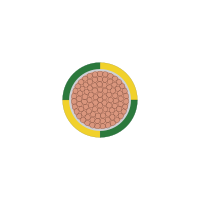
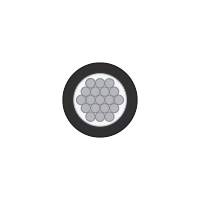
Tinned copper wire features a micro-layer of tin over each copper strand. This tin barrier prevents oxidation, protects the wire from corrosion, and ensures the cable lasts for the 25-year lifespan of your solar panels.
Tinned Copper Solar Wire 6mm vs 4mm: The Core Differences
In the solar industry, wire sizes are typically measured in cross-sectional area (square millimeters, or $mm^2$). The two most common sizes used in residential string inverters and microinverter setups are 4mm² (roughly 11 AWG) and 6mm² (roughly 10 AWG).
| Feature | 4mm² Tinned Copper Wire | 6mm² Tinned Copper Wire |
| Cross-Sectional Area | $4 \text{ mm}^2$ | $6 \text{ mm}^2$ |
| Current Carrying Capacity (Ampacity) | Up to ~40–55 Amps (depending on layout) | Up to ~55–70 Amps (depending on layout) |
| Resistance (per km) | Higher (~$5.09 \ \Omega/\text{km}$) | Lower (~$3.39 \ \Omega/\text{km}$) |
| Best Used For | Short runs, lower current strings | Long runs, high-current arrays |
| Cost | More budget-friendly | Higher upfront investment |
The Physics of Efficiency: Voltage Drop Explained
When evaluating solar wire efficiency, the most important metric is voltage drop.
As electricity travels from your solar roof array to the inverter, it encounters natural resistance within the wire. This resistance converts a portion of your hard-earned solar energy into waste heat. The law of physics here is simple: a thicker wire offers a wider path for electrons, which results in lower resistance and less power loss.
The power loss in a cable can be expressed by the formula:
$$P_{\text{loss}} = I^2 \cdot R$$
Where $I$ is the current (amperage) and $R$ is the electrical resistance of the wire. Because resistance decreases as the cross-sectional area increases, a 6mm² wire inherently loses less energy than a 4mm² wire over the exact same distance.
The 3% Golden Rule in Solar Design
Industry standards recommend keeping the total voltage drop in a solar DC system under 3%, though top-tier installers aim for under 1% to maximize efficiency.
- 4mm² Wire Efficiency: If your solar panels are close to your inverter (a wire run of under 10–15 meters) and your string current is moderate (around 10–12 Amps), a 4mm² wire will easily keep your voltage drop well under 1%.
- 6mm² Wire Efficiency: If your wire run exceeds 15 meters, or if you are combining multiple strings into a high-amperage array, the resistance of a 4mm² wire will cause the voltage drop to creep up. Upgrading to a 6mm² wire minimizes this drop, reclaiming energy that would otherwise be lost.
Real-World Scenario: When Does 6mm² Matter?
Let’s look at a realistic residential scenario. Imagine a standard 5kW solar array generating a string current of 11 Amps at a DC voltage of 400V.
- The Short Run (10 Meters): Over a short 10-meter distance from the roof to the garage inverter, both 4mm² and 6mm² wires will perform exceptionally well. The efficiency difference between them might only amount to a few kilowatt-hours over an entire year—hardly enough to justify a price difference.
- The Long Run (30 Meters): If your inverter is located far away in a basement or utility room, a 30-meter wire run changes the math. A 4mm² wire will experience a much higher voltage drop over this distance. Switching to a 6mm² wire cuts the resistance by roughly 33%, protecting your system’s output and paying for itself over time through saved energy.
Which One Should You Choose for Your Home?
Instead of guessing, use these practical guidelines to determine which tinned copper wire fits your home solar blueprint:
Choose 4mm² Tinned Copper Wire if:
- The distance between your solar panel array and your inverter is short (under 15 meters / 50 feet).
- You are installing a microinverter system (where DC power is converted to AC right on the roof, meaning shorter DC cable runs).
- Your system operates at a lower total current (Amperage).
- You are working on a tighter budget and your system design already guarantees negligible voltage drop.
Choose 6mm² Tinned Copper Wire if:
- Your cable run is long (greater than 15–20 meters).
- You live in an area with high ambient temperatures (heat increases electrical resistance; the thicker 6mm² wire handles thermal stress better).
- You are planning a high-current system or intend to expand your panel array in the future.
- You want to future-proof your installation for maximum energy yield over the next 25 years.
Conclusion: Don’t Bottleneck Your Green Energy
Your solar panels are only as good as the wires connecting them to your home. While 4mm² tinned copper solar wire is an excellent, cost-effective choice for compact systems with short cable runs, 6mm² wire is the clear winner for longer distances and high-temperature environments.
Investing a little extra upfront in 6mm² tinned copper wire ensures that your home solar system operates at peak efficiency, minimizing power degradation and maximizing your return on investment for decades to come.
About the Author

Ahmad Raza Ali is a Digital Marketing Manager and technical content strategist specializing in renewable energy infrastructure and industrial cable specifications. With a deep focus on search engine optimization and E-E-A-T principles, Ahmad bridges the gap between complex electrical engineering standards (IEC/BS) and practical consumer solar applications. He has been working with LifeCables.com and its sister TaxAccountant.pk as an SEO Analyst for long. He is a BBA cont. undergraduate as well with majors in marketing studying at SZABIST ISB.