






Load Capacity of 7/52 Single Core Wire for Commercial Buildings – Best Guide for users


The Real-World Load Capacity of 7/52 Single Core Wire in Commercial Buildings
When designing or upgrading the electrical infrastructure of a commercial building, you can’t afford to guess. Unlike residential settings where loads are intermittent, commercial spaces—like retail hubs, data offices, and light industrial units—run under continuous, punishing loads.
Among the various wiring specifications used by electrical contractors, 7/52 single-core copper wire is a frequently discussed option. But what exactly is its load capacity when installed within the complex environments of modern commercial structures?
Let’s skip the generic textbook definitions and dive straight into the practical math, real-world variables, and E-E-A-T (Experience, Expertise, Authoritativeness, and Trustworthiness) principles that engineers use to evaluate this specific conductor.
What Does “7/52” Actually Mean?
Before calculating current-carrying capacity, we have to unpack the empirical naming convention.
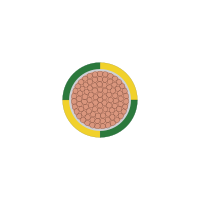
- The ‘7’: Represents the number of individual copper strands bundled together to form the single core. Stranded wire is favored in commercial applications because it offers flexibility and resists structural vibration better than solid-core wire.
- The ’52’: Refers to the Standard Wire Gauge (SWG) of each individual strand. A 52 SWG measurement corresponds to a strand diameter of 0.022 inches (approximately 0.56 mm).
When these seven strands are combined, they provide a total cross-sectional area roughly equivalent to 1.5 mm² to 1.78 mm² (depending on the manufacturing tolerances and insulation standard applied, such as BS 6004 or regional metrics). This places it squarely in the category of a light-to-medium branch circuit wire.
The Nominal Current Capacity: The Baseline
In a controlled laboratory environment at an ambient room temperature of 30°C (86°F), a 7/52 single-core copper wire with standard PVC insulation has a nominal current-carrying capacity of 15 to 18 Amperes.
To convert this to power (watts), we use the standard electrical formula:
$$\text{Power (Watts)} = \text{Voltage (V)} \times \text{Current (A)} \times \text{Power Factor (PF)}$$
For a standard single-phase commercial branch circuit operating at 220V with a conservative power factor of 0.8:
$$\text{Power} = 220 \times 15 \times 0.8 = 2,640 \text{ Watts (2.64 kW)}$$
At a higher efficiency tier or purely resistive load (PF = 1.0):
$$\text{Power} = 220 \times 18 \times 1.0 = 3,960 \text{ Watts (3.96 kW)}$$
Expert Warning: The nominal rating is a baseline trap. If you design a commercial electrical panel assuming a flat 18-amp limit for 7/52 wire, you are setting the stage for a critical system failure, localized overheating, or a code violation.
Commercial Derating Factors: The Real-World Math
In commercial buildings, cables are almost never run in isolation through cool, open air. They are packed into conduits, pulled through tight cable trays, and routed through hot ceiling voids. To prevent the degradation of the PVC insulation, we must apply derating factors.
1. The 80% Continuous Load Rule
National electrical codes (such as the NEC or IEC equivalents) state that for commercial applications, a branch circuit must not be loaded beyond 80% of its capacity for a continuous load (any load running uninterrupted for 3 hours or more).
- Adjusted Capacity: $15\text{A} \times 0.80 = 12\text{A}$
2. Conduit Bundling (Thermal Proximity)
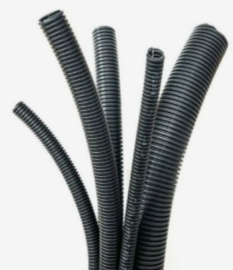
When you pull multiple single-core wires through a single conduit or trunking, they trap each other’s heat. If you run 4 to 6 active 7/52 single-core wires together, the international standards require a bundling correction factor of roughly 0.80.
- Adjusted Capacity: $12\text{A} \times 0.80 = 9.6\text{A}$
3. Ambient Environmental Temperature
Commercial ceiling plenums and electrical closets can easily reach ambient temperatures of 40°C to 45°C (104°F to 113°F) during peak summer months. PVC insulation rated for 70°C must be derated by a factor of 0.87 under these conditions.
- Final Safe Operating Capacity: $9.6\text{A} \times 0.87 \approx 8.35\text{A}$
Look at the difference: A wire that safely handles 15–18 amps on paper drops to a real-world safe capacity of 8.35 to 10 Amperes in a harsh commercial deployment.
Where Can 7/52 Single-Core Wire Be Safely Used in Commercial Buildings?
Given its real-world limitations, 7/52 single-core wire is highly effective when confined to specific branch circuits and low-draw systems.
| Approved Commercial Application | Load Suitability | Best Practice Note |
| LED Lighting Networks | Excellent | Perfect for modern energy-efficient commercial lighting arrays. |
| Office Workstation Outlets | Moderate | Safe for desktop computers and monitors; avoid daisy-chaining spaces. |
| HVAC Control Signaling | Excellent | Ideal for thermostats, dampers, and building management system (BMS) logic paths. |
| Dedicated Security Systems | Excellent | Used for CCTV power feeds, access control panels, and fire alarm peripherals. |
Where to Absolutely Avoid It
- Server Rooms & PDU Feeds: The harmonic currents generated by enterprise servers will cause 7/52 wires to overheat rapidly.
- Commercial Kitchen Equipment: Industrial microwaves, refrigerators, and ovens pull far more current than this cross-sectional area can sustain.
- Main Feeders or Sub-Panels: 7/52 is strictly a branch-circuit or control wire; it should never be used as a primary supply line.
Voltage Drop Considerations for Long Commercial Runs
Commercial buildings feature long architectural layouts. A branch circuit traveling from an electrical closet to an end-of-hallway asset can easily exceed 30 meters (100 feet).
Because 7/52 wire has a smaller cross-sectional area than thicker counterparts (like 7/44 or 7/36), its internal electrical resistance is higher. Over long distances, this resistance causes a noticeable voltage drop.
Most strict building codes dictate that voltage drop on a branch circuit must not exceed 3% to ensure equipment operates efficiently. If a 7/52 cable is pushed to its 10A limit over a distance of more than 25 meters, the voltage drop will likely breach this 3% threshold, causing flickering lights, equipment malfunctions, or data corruption in electronic devices. For long runs, it is always wise to upsize the conductor.
Final Verdict for Project Managers
If you are specifying materials for a commercial project, 7/52 single-core wire is safe to use for loads up to 10 Amperes in real-world environments. Treat it as a dedicated 10A circuit wire, protect it with a properly rated 10A circuit breaker, and restrict its usage to lighting arrays, light-duty office outlets, and signal circuitry.
Investing in high-quality, pure-copper single-core wire with flame-retardant PVC insulation ensures compliance, long-term building safety, and system resilience.
