




Best High-Quality 7/64 Cable for Industrial Power Distribution | Guide


The Backbone of Modern Power: A Field Guide to 7/64 Cable in Industrial Distribution
Walk into any heavy manufacturing facility, automotive assembly plant, or automated processing hub, and you’ll find an intricate web of electrical infrastructure keeping the lights on and the machines running. In these high-stakes environments, the margin for error is non-existent. A single power disruption can cost thousands of dollars per minute in lost productivity.
When engineers and electrical contractors design system distribution architectures, they look for conductors that strike a flawless balance between raw current-carrying capacity, structural flexibility, and long-term environmental resilience.
That is exactly where the 7/64 cable enters the conversation.
While it might sound like just another technical specification on a blueprint, this specific conductor configuration is a workhorse of industrial power distribution. Let’s dive deep into what makes a 7/64 cable high-quality, how it functions under grueling industrial workloads, and how to choose the right variant for your next infrastructure project.
Anatomy of a Workhorse: What Exactly is a 7/64 Cable?
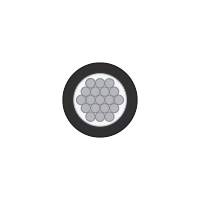
In the world of electrical engineering, cable naming conventions tell a precise story about a product’s internal architecture. When we talk about a 7/64 cable, we are describing a stranded conductor comprised of:
- 7 distinct wire cores or strands.
- Each individual strand measuring 64 mils (or $0.064 \text{ inches}$) in diameter.
Why choose a stranded 7/64 configuration over a single, solid conductor of equivalent cross-sectional area? The answer comes down to practical physics and structural real-world installation requirements.
1. Flex Life and Mechanical Agility
Solid metal rods are rigid. If you attempt to pull a thick, solid copper or aluminum conductor through a complex network of industrial conduits, sharp bends, and tight cable trays, it will resist. Worse, repeated bending causes work-hardening, leading to microscopic fractures and eventual structural failure. A 7-strand configuration allows the individual wires to slide slightly against one another, offering superior flexibility without sacrificing metallic mass.
2. Overcoming the Skin Effect
In AC (alternating current) distribution systems, electrical current tends to distribute itself non-uniformly, flowing predominantly near the outer surface—the “skin”—of the conductor. By utilizing a multi-stranded layout like 7/64, the effective surface area of the conductor is optimized relative to its total mass, ensuring stable current distribution and minimized resistive losses under heavy loads.
Material Science: Copper vs. Aluminum in High-Quality Manufacturing
A 7/64 specification is only as good as the metallurgy behind it. High-quality industrial power cables generally rely on two primary metals, each serving specific operational profiles.
| Feature / Property | Electrolytic Tough Pitch (ETP) Copper | Aluminum Alloy (e.g., AA-8000 Series) |
| Electrical Conductivity | Extremely High (~100% IACS) | Moderate (~61% IACS) |
| Weight Profile | Heavy; requires robust structural support | Lightweight; ideal for long overhead spans |
| Oxidation Vulnerability | Low; forms a stable, conductive patina | High; requires specialized termination paste |
| Cost-Efficiency | Higher initial capital expenditure | Highly cost-effective for large-scale runs |
For premium industrial applications where space inside conduits is restricted and maximum reliability is required, annealed bare or tinned copper remains the gold standard. Tinning the individual copper strands provides an extra layer of defense against corrosive chemical vapors, moisture, and oxidation—common hazards in wastewater treatment plants and chemical processing facilities.
Insulation and Jacketing: The First Line of Defense
An industrial cable is only as safe as its insulation jacket. High-quality 7/64 cables do not use generic, commercial-grade PVC. Instead, industrial power distribution demands engineered polymers designed to withstand thermal cycling, physical abrasions, and chemical exposure.
XLPE (Cross-Linked Polyethylene)
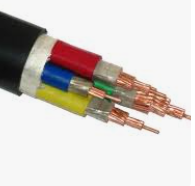
XLPE is a premier insulation material for industrial power. Through a chemical or thermal process, the molecular chains of polyethylene are linked into a three-dimensional network. This cross-linking prevents the polymer from melting or flowing at elevated temperatures. XLPE-insulated 7/64 cables can comfortably handle continuous operating temperatures of 90°C and short-circuit emergency temperatures up to 250°C.
LSZH (Low Smoke Zero Halogen)
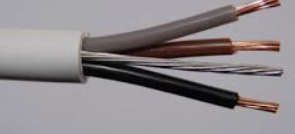
If your power distribution layout passes through enclosed spaces, tunnels, or areas with high concentrations of human personnel, an LSZH jacket is essential. Standard plastics release toxic, corrosive halogen gases (like hydrogen chloride) when ignited. LSZH jackets ensure that, in the event of an electrical fire, smoke emission is minimal and completely non-toxic, protecting both human lives and sensitive electronic control rooms nearby.
SWA (Steel Wire Armor)
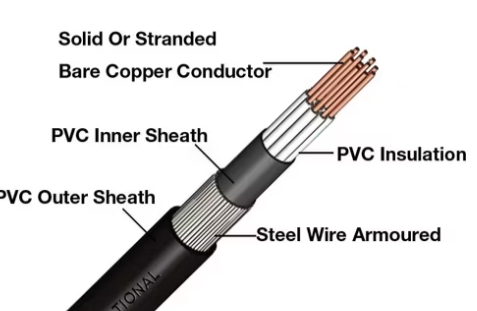
For direct burial or areas prone to mechanical impacts (such as open factory floors with forklift traffic), the 7/64 core is enclosed within a layer of galvanized steel wire armor. This eliminates the need for expensive rigid metal conduit runs, saving massive labor costs during plant deployment.
Critical Engineering Standards: Verification Matters
You cannot afford to take a manufacturer’s word at face value when deploying infrastructure. High-quality 7/64 cables must be tested, vetted, and certified by independent international regulatory bodies. When auditing a batch of cables for your facility, ensure they bear the stamps of compliance for these key standards:
- IEC 60502-1: Specifies the construction, dimensions, and test requirements for power cables with extruded insulation for rated voltages from $1 \text{ kV}$ up to $3 \text{ kV}$.
- BS 5467 / BS 6724: British Standards governing armored cables for electricity supply, ensuring the jacket can withstand severe mechanical stress.
- PSQCA (Pakistan Standards and Quality Control Authority): Crucial for localized regional projects, ensuring compliance with domestic grid tolerances and thermal performance metrics under high ambient temperature conditions.
Installation Best Practices for Long-Term Reliability
Even the highest-quality cable will fail prematurely if handled incorrectly during installation. Keep these three ground rules in mind:
- Respect the Bending Radius: For unarmored 7/64 cables, the minimum bending radius is typically 4 to 6 times the overall cable diameter. For armored (SWA) variants, this increases to 12 times the diameter. Bending past this limit kinks the internal strands and compromises the insulation’s dielectric strength.
- Calculate Voltage Drop Proactively: Over long industrial cable runs, resistance builds up. Ensure your 7/64 layout accounts for voltage drop limits (typically kept under 3% for power branch circuits) to prevent industrial motors from overheating due to undervoltage.
- Torque Terminals to Specification: Loose terminations create high-resistance micro-environments. Over time, these hotspots degrade the cable connection, leading to thermal failure or electrical arcs. Use calibrated torque wrenches during installation.
Final Thoughts: Investing in Operational Continuity
In industrial power distribution, saving a few pennies on sub-standard cable infrastructure is a classic example of being penny-wise and pound-foolish. Selecting a high-quality, certified 7/64 cable with robust XLPE or LSZH insulation ensures that your facility remains safe, efficient, and operational for decades to come. Always source your conductors from manufacturers who provide transparent material tracking, verified test certifications, and clear structural compliance sheets.
