




1mm^2 (40/.0076) Copper Cables (Single Core vs 2 Cores) – Best Guide 2026


Understanding 1mm^2 (40/.0076) Copper Cables: Single Core vs 2 Cores
If you have ever stood in an electrical supply shop or browsed an online supplier catalog, you have probably noticed that cable sizing can look like a completely foreign language. You see terms like 1mm^2 right next to old imperial numbers like 40/.0076″.
When it comes to wiring light fixtures, connecting fans, or setting up low-power control systems, this specific size is an absolute industry staple. But choosing between a Single Core and a 2 Cores (Twin Core) cable is where many DIYers, property owners, and even junior technicians get stuck.
Let’s break down the technical jargon, compare single vs. multi-core configurations, and look at exactly how to pick the right wire for your project while keeping safety standards front and center.
Deciphering the Specs: What Does 40/.0076″ Actually Mean?
Before we look at cores, let’s unpack the code on the cable jacket.
Electrical wires are categorized by two sizing systems: the modern metric system (cross-sectional area in square millimeters) and the legacy imperial standard (inches).
- 1mm^2 (Metric): This refers to the total cross-sectional area of the copper conductor. It tells you how much copper is physically present to carry electrical current.
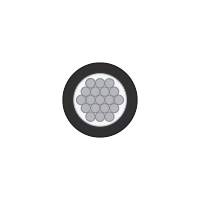
- 40/.0076″ (Imperial): This represents the physical construction of a flexible, stranded conductor.
- The first number (40) means there are exactly 40 individual, fine strands of copper twisted together.
- The second number (0.0076″) is the exact diameter of each individual strand in inches.
Why Stranded Copper Matters
Using 40 fine strands instead of a single solid chunk of copper makes the wire highly flexible. This flexibility makes it much easier to pull through narrow conduits, snake behind drywall, or twist through tight corners without the metal fatiguing or breaking.
Single Core vs. 2 Cores: The Core Differences
The primary distinction between these two options is how many insulated channels live inside the outer protective layer.
1. 1mm^2 Single Core Cable
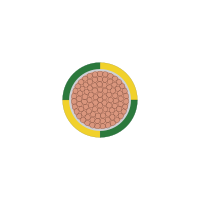
A Single Core cable features one bundle of 40/.0076″ copper strands wrapped in a single layer of PVC insulation.
- How it’s used: You rarely run a single core wire completely on its own through a building. Instead, multiple single-core wires (typically red/brown for live, blue/black for neutral, and green/yellow for earth) are pulled together through a protective PVC or metal conduit channel.
- Best for: Internal conduit wiring in residential walls, industrial control panels, switchgear wiring, and distribution boards where individual routing is necessary.
2. 1mm^2 2 Cores (Twin Core) Cable
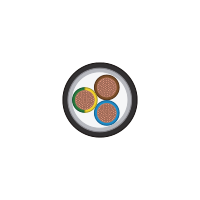
A 2 Cores cable houses two separate insulated bundles of 40/.0076″ copper strands running parallel to each other, bound together under a secondary outer PVC protective sheath.
- How it’s used: This is an all-in-one circuit solution. One inner core acts as the live conductor, and the other acts as the neutral. Because it features a secondary outer jacket, it provides extra mechanical protection.
- Best for: Surface-mounted wiring, pendant lighting drops, extension cords for low-power appliances, and exposed wiring routes where running a dedicated rigid conduit is impractical.
Technical Specifications & Current Carrying Capacity
When choosing electrical wiring, guessing isn’t an option. Operating a cable beyond its rated capacity creates a fire hazard because excessive electrical resistance causes heat build-up that can melt PVC insulation.
Here is a quick look at the typical operational metrics for high-quality $1\text{ mm}^2$ (40/.0076″) pure copper cables under standard conditions:
| Specification Parameter | Single Core Value | 2 Cores (Twin) Value |
| Conductor Material | 99.9% Pure ETP Copper | 99.9% Pure ETP Copper |
| Strand Configuration | 40 wires × 0.0076 inches | 40 wires × 0.0076 inches per core |
| Approx. Current Rating | 10 to 12 Amps (In Conduit) | 8 to 10 Amps (Enclosed/Clipped) |
| Voltage Rating ($U_0/U$) | 300/500V or 450/750V | 300/500V |
| Compliance Standards | IEC 60227 / BS 6004 | IEC 60227 / BS 6004 |
An Important Note on Amperage: The current rating changes based on your installation method. Single core wires bundled together inside a sealed wall conduit trap heat more easily than a twin-core cable suspended in free air. Always reference local wiring regulations (such as BS 7671 or national equivalents) before finalizing your load calculations.
How to Avoid Counterfeits:
Because 1mm^2 wire is used so heavily in household lighting circuits, the market is unfortunately flooded with substandard, counterfeit cables. Low-quality manufacturers often use CCA (Copper-Clad Aluminum) instead of pure copper, or cut down the strand count to 30 or 35 while still labeling it 40/.0076″.
CCA has much higher electrical resistance than pure copper, which can cause the wire to overheat under a standard 10-amp load. When sourcing your cable, always keep these field verification tips in mind:
- Verify the Weight and Flex: Pure copper is heavier and holds its shape slightly when bent. If the cable feels incredibly light or springs back like plastic, it might be aluminum-core.
- Scrape the Strands: Use a utility knife to lightly scrape the surface of one of the 40 strands. If a silver-white color appears underneath the top layer, it is copper-clad aluminum. It must remain deep orange-gold throughout.
- Look for Cable Markings: Reliable manufacturers print laser markings or embossed text on the PVC insulation every meter. Look for explicit certification stamps like “IEC 60227”, “BS 6004”, or reputable local quality marks.
Frequently Asked Questions (FAQs)
Can I use a 1mm^2 (40/.0076″) cable for ceiling fans?
Yes. A typical residential ceiling fan draws between 50W and 100W, which translates to less than 0.5 Amps of current. A 1mm^2 cable handles this load safely with plenty of room to spare.
What is the maximum wattage a 40/.0076″ cable can handle?
On a standard 220V–240V domestic power supply, a 1mm^2 cable rated safely for 10 Amps can handle a maximum continuous load of up to 2,200 Watts (2.2kW). On a 110V system, that maximum threshold drops to 1,100 Watts.
Is 40/.0076″ suitable for air conditioners or kitchen appliances?
No. Main appliances like inverter air conditioners, refrigerators, electric kettles, and microwaves draw heavy currents that often exceed 15 to 20 Amps. For those heavy loads, you should use larger cables like 2.5mm^2 (70/.0076″) or 4mm^2 cables to ensure safe operation.
About the Author

Ahmad Raza Ali is a Digital Marketing Manager and technical content strategist specializing in renewable energy infrastructure and industrial cable specifications. With a deep focus on search engine optimization and E-E-A-T principles, Ahmad bridges the gap between complex electrical engineering standards (IEC/BS) and practical consumer solar applications. He has been working with LifeCables.com; its sister company TaxAccountant.pk and MechaFuze an SEO Executive for long. He is a BBA cont. undergraduate as well with majors in marketing studying at SZABIST ISB.