




Best 10mm Solar Cable Price for Commercial Solar Plants Pakistan (2026)


10mm Solar Cable Price for Commercial Solar Plants in Pakistan: The Industrial Buyer’s Guide
When shifting a commercial or industrial facility to solar power in Pakistan, it is easy to get caught up in the big-ticket items. We spend weeks debating N-type vs. P-type Tier-1 solar panels, comparing the efficiency curves of central vs. string inverters, and finalizing net metering applications with NEPRA.
But out in the field, under the harsh Pakistani sun, the true lifeline of your multi-million rupee investment comes down to something much humbler: the DC wiring.
For commercial installations ranging from 50kW to over 500kW, the 10mm² solar cable is the industry standard for a reason. It handles the heavier current loads over longer distances without breaking a sweat. However, if you are an administrative manager, procurement officer, or project engineer, you know that pricing this component isn’t as simple as checking a standard rate list.
Having audited and consulted on multiple commercial power setups in Gujranwala, Lahore, Faisalabad, Sialkot, Sheikhupura and Rawalpindi, I have seen firsthand how minor procurement oversights in string wiring lead to major system bottlenecks. Let’s break down the current market prices for 10mm solar cables in Pakistan, the hidden factors driving those costs, and how to spot a high-quality cable that won’t fry your system.
What is the Current 10mm Solar Cable Price in Pakistan?
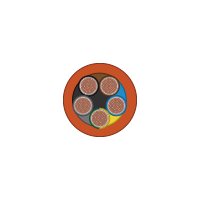
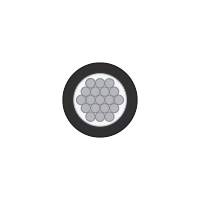
Let’s get straight to the numbers. Based on recent supplier quotes and market verifications across major commercial hubs, high-quality, certified 10mm single-core flexible DC solar cables generally range from PKR 280 to PKR 420 per meter.
If you are buying in bulk for a commercial-scale project (typically by the coil, which comes in 100-meter or 90-meter rolls, or large wooden drums), your per-meter cost can vary significantly based on volume and manufacturer.
Estimated Cost Breakdown Table
| Cable Specification | Price Range (Per Meter) | Price Range (Per 100M Coil) | Common Commercial Applications |
| 10mm² Tinned Copper (Imported/Premium) | PKR 350 – PKR 420 | PKR 35,000 – PKR 42,000 | Long DC runs, high-voltage utility strings, high-humidity regions. |
| 10mm² Tinned Copper (Local Top-Tier) | PKR 280 – PKR 340 | PKR 28,000 – PKR 34,000 | Standard commercial rooftops, industrial setups, distribution boxes. |
| 10mm² Bare Copper / Low-Grade Alternative | PKR 180 – PKR 240 | PKR 18,000 – PKR 24,000 | Not recommended for commercial PV applications. |
Procurement Note: Because solar cables are heavily dependent on international copper commodity rates and fluctuating import margins in Pakistan, these prices experience frequent shifts. Always request a formal, time-bound quote from your supplier before closing your project budget.
Why 10mm? Understanding the Engineering Behind the Choice
In residential 3kW or 5kW systems, a 4mm² or 6mm² cable is usually more than enough to handle the current. However, commercial solar plants operate on an entirely different scale.
As a commercial plant grows, the distance between your solar panel arrays on the rooftop and the inverters on the ground or plant floor increases. When electricity travels over longer distances, it encounters resistance. If your cable is too thin, you experience voltage drop.
A voltage drop of more than 1% to 2% in your DC strings doesn’t just mean a loss of efficiency; over a 25-year lifecycle, that tiny drop compounds into millions of lost rupees in ungenerated power. A 10mm² cross-sectional area provides the thick pathways needed to minimize resistance, keeping your voltage stable and your system running cool even when ambient temperatures cross 45°C in regions like Faisalabad, Sheikhupura, Lahore.
The Core Drivers of 10mm Solar Cable Pricing in Pakistan
When evaluating engineering quotes from vendors in markets like Lahore’s Shah Alam Market, Karachi’s Saddar, or Rawalpindi’s College Road, you will notice massive price disparities. In our technical audits, we consistently trace these cost gaps back to three specific manufacturing factors:
1. Tinned Copper vs. Pure Bare Copper
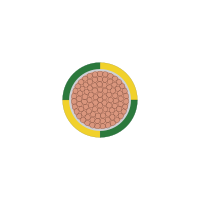
This is where low-bid contractors cut corners to present an artificially lower bill of materials (BOM). A true solar DC cable must use tinned copper strands. Coating each individual copper strand with a micro-layer of tin protects the metal from oxidation and corrosion.
Because solar plants are exposed to atmospheric moisture, rain, and industrial pollution, bare copper degrades quickly, leading to high resistance and fire hazards. Tinned copper costs more up front, but it is non-negotiable for commercial longevity.
2. Insulation Integrity (XLPO Dual-Wall)
Standard electrical wire uses simple PVC insulation. Solar cables require Cross-linked Polyolefin (XLPO) dual-wall insulation.
- The Outer Layer: Provides intense UV protection, weather resistance, and flame-retardant properties.
- The Inner Layer: Offers high dielectric strength to handle voltages up to 1,500V DC.
Cables utilizing genuine XLPO insulation command a premium over generic rubber or low-grade plastics.
3. Compliance with International Standards and NEPRA Regulations
For commercial audits and structural safety, your cables must meet international benchmarks. Furthermore, choosing certified cables ensures your plant passes the strict structural inspection audits required for NEPRA Net Metering licensing. Look for markings on the cable sheath indicating compliance with:
- EN 50618 (The European standard for photovoltaic system cables)
- IEC 62930 (International Electrotechnical Commission standards for PV cables)
Manufacturing to these standards requires rigorous testing, which reflects in the final market price.
How to Avoid Counterfeits and Low-Spec Cables
In Pakistan’s solar supply chain, sub-standard materials are a persistent issue. When approving a cable batch for your commercial site, use this field checklist to verify authenticity:
- Check the Print Legend: Legitimate manufacturers cleanly print specifications every meter along the cable jacket. It should clearly read:
PV1-F 1x10mm², the rated voltage (1.5kV DC), the relevant standard (EN 50618orIEC 62930), and a visible brand name like Pakistan Cables or Fast Cables . - The Scrap Test: Scrape the silver-colored strands with a knife. If it reveals bright, reddish-gold copper underneath, it is genuine tinned copper. If the metal breaks easily or looks dull grey all the way through, it might be dangerous copper-clad aluminum (CCA).
- Flexibility Check: High-quality 10mm solar cables utilize Class 5 flexible stranded conductors. If the cable feels stiff and rigid like a standard utility wire, it will crack under thermal expansion and contraction over time.
Final Verdict: Balancing Upfront Cost with 25-Year ROI
When managing a commercial solar build, saving a few thousand rupees on a lower-grade 10mm cable can feel like a quick win for your procurement metrics. But a single cable failure can cause arc faults, damage your multi-string inverters, or worse, trigger a catastrophic rooftop fire that shuts down your entire commercial operation.
Invest in certified, tinned-copper 10mm solar cables from reputable brands or verified importers. The peace of mind, system safety, and optimized energy yields over the next two decades far outweigh the minor upfront price difference.