



Best Guide for OPGW Fiber Optic Monitoring – 2026


Learn how OPGW Fiber Optic Monitoring is done and Important
When you look up at those massive steel towers marching across the landscape, carrying the lifeblood of our modern world, you’re usually looking at the thick, un-insulated aluminium conductors. But at the very top of those towers sits a thinner, unassuming wire that is arguably the most hardworking component of the entire circuit.
That wire is OPGW (Optical Ground Wire).
For decades, it served a singular, protective purpose: shielding the lines from lightning. But today, thanks to the marriage of telecommunications and heavy power engineering, OPGW has become the “nervous system” of the smart grid.
In this deep dive, we’re going to look at why OPGW is the gold standard for high-voltage transmission monitoring, how it works, and why it’s the unsung hero of energy reliability.
What Exactly is OPGW?
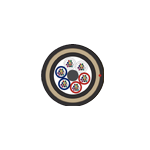
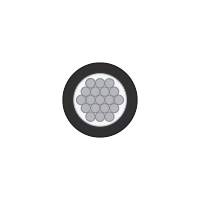
At its core, OPGW is a dual-purpose cable. It replaces the traditional static or shield wire on top of transmission towers. It performs two critical roles:
- Grounding/Shielding: It protects the underlying phase conductors from lightning strikes and provides a path for fault currents.
- Fiber Optic Communication: Tucked inside its metallic core is a bundle of optical fibers. These fibers are immune to the massive electromagnetic interference (EMI) generated by high-voltage lines, making them the perfect medium for high-speed data transmission.
Why OPGW Fiber Optic Monitoring Matters Now More Than Ever
The “set it and forget it” era of utility management is over. With the integration of volatile renewable energy sources (like wind and solar) and the increasing frequency of extreme weather events, grid operators need real-time data.
If a line sags too low due to heat, it can arc and start a fire. If a tower is vibrating excessively due to wind (aeolian vibration), it can lead to structural failure. OPGW doesn’t just sit there; it acts as a continuous sensor.
The Superpowers of OPGW Monitoring
By leveraging the fiber optics inside the OPGW, utilities can implement Distributed Fiber Optic Sensing (DFOS). This turns miles of cable into thousands of virtual sensors.
1. Real-Time Thermal Monitoring (DTS)
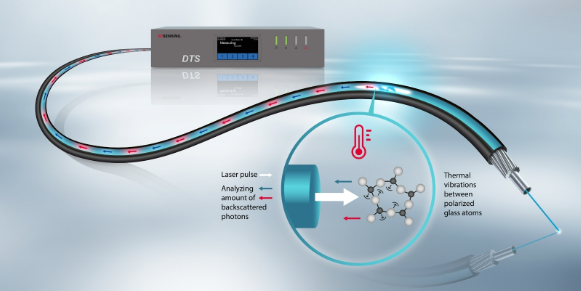
Using Distributed Temperature Sensing (DTS), operators can see the temperature profile of the line at every meter. This allows for Dynamic Line Rating (DLR). Instead of guessing how much current a wire can handle based on the weather forecast, operators can push more power through the lines safely because they know exactly how hot the cable is in real-time.
2. Mechanical Strain and Vibration (DAS/DSS)
Distributed Acoustic Sensing (DAS) can detect the “signature” of various mechanical threats.
- Ice Loading: Detecting the weight of ice before a line snaps.
- Physical Security: Sensing if someone is climbing a tower or attempting to tamper with the infrastructure.
- Aeolian Vibration: Identifying high-frequency vibrations that cause fatigue in the hardware.
3. Fault Location
When a fault occurs (like a branch falling on a line), the OPGW communication link allows protection relays to communicate instantly. This “teleprotection” can isolate the fault in milliseconds, preventing a localized spark from becoming a regional blackout.
Why Utilities Trust OPGW
- Longevity (Experience): OPGW has been in use since the late 1970s. We have decades of data proving its durability in harsh environments, from salt-sprayed coasts to frozen mountain peaks.
- Reliability (Trust): Unlike wireless or satellite monitoring, which can be affected by weather or solar flares, fiber optics inside OPGW are shielded by heavy aluminum and steel. It is the most secure “hardwired” connection possible for critical infrastructure.
Installation and Challenges: A Realistic View
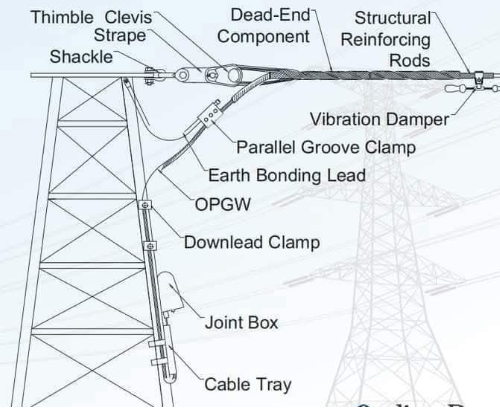
I won’t tell you that OPGW is a “plug-and-play” solution. It requires specialized expertise. Installing OPGW on an existing live line (known as a “live-line retrofit”) involves massive tensioning equipment and specialized crews who work around high-voltage environments.
The fiber optics themselves are delicate—smaller than a human hair—but they are encased in stainless steel tubes or plastic buffers within the OPGW. The “secret sauce” of a high-quality OPGW cable is the excess fiber length (EFL). This ensures that when the outer metal cable stretches due to wind or ice, the glass fibers inside don’t snap.
The Future: OPGW and the Green Transition

As we transition to a greener grid, the demand for OPGW is skyrocketing. Offshore wind farms and remote solar arrays need to send vast amounts of data back to central command. OPGW is the bridge.
Furthermore, many power utilities are now becoming “dark fiber” providers. They lease the extra fibers inside their OPGW to internet service providers (ISPs), helping bring high-speed internet to rural areas that were previously unreachable. It’s a win-win for infrastructure and the community.
Final Thoughts
OPGW is more than just a wire; it is the intelligence layer of the modern world. It protects our grid from the heavens (lightning) while providing the data we need to manage our energy future on earth. For utility managers, investing in high-quality OPGW monitoring isn’t an expense—it’s an insurance policy for the 21st century.