





Low Smoke Zero Halogen LSZH Armoured Cables for Public Infrastructure Projects 2026 Best Guide


The Backbone of Public Safety: A Deep Dive into Low Smoke Zero Halogen LSZH Armoured Cables
When we walk through a bustling underground station, check into a modern hospital, or navigate a crowded airport terminal, we rarely think about what’s happening behind the walls or beneath our feet. We take for granted that the lights will stay on and the emergency systems will function.
However, for those of us in the electrical and construction industries, those “hidden” details are everything. In the world of public infrastructure, the choice of cabling isn’t just a technical specification—it’s a critical safety decision. That is where BS 6724 comes in.
If you are managing a high-traffic project, understanding why BS 6724 Low Smoke Zero Halogen (LSZH) Armoured Cables are the industry standard isn’t just helpful—it’s mandatory for compliance and, more importantly, for saving lives.
What is BS 6724?
In simple terms, BS 6724 is the British Standard that specifies requirements for armored cables that have low emission of smoke and corrosive gases when affected by fire.
Unlike its cousin, the BS 5467 (which uses PVC), BS 6724 cables are designed specifically for environments where smoke and acid gas evolution could pose a major hazard to people and sensitive equipment.
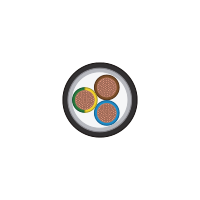
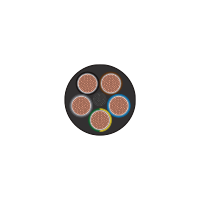
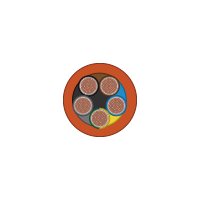
Anatomy of a BS 6724 Cable
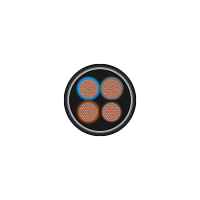
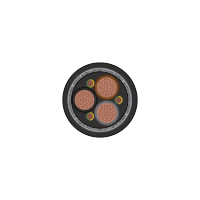
To understand its value, we need to look at what’s inside:
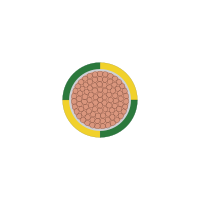
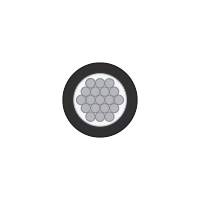
- Conductor: Usually plain annealed stranded copper (Class 2).
- Insulation: Cross-linked Polyethylene (XLPE), allowing for higher operating temperatures (up to 90°C).
- Bedding: A Low Smoke Zero Halogen (LSZH) compound.
- Armouring: Steel Wire Armour (SWA) for multi-core cables or Aluminum Wire Armour (AWA) for single-core cables to prevent magnetic heating.
- Oversheath: A final layer of UV-stable LSZH compound.
Why “Low Smoke Zero Halogen” Matters
In the event of a fire, the primary cause of casualty is rarely the flames themselves; it is smoke inhalation and disorientation.
1. Visibility and Evacuation
Standard PVC cables release thick, black, acrid smoke when burned. In a confined space like a tunnel or a high-rise, this smoke can reduce visibility to near zero within seconds. LSZH cables, as the name suggests, emit very little smoke, keeping exit signs visible and evacuation routes clear.
2. Toxicity and Acid Gases
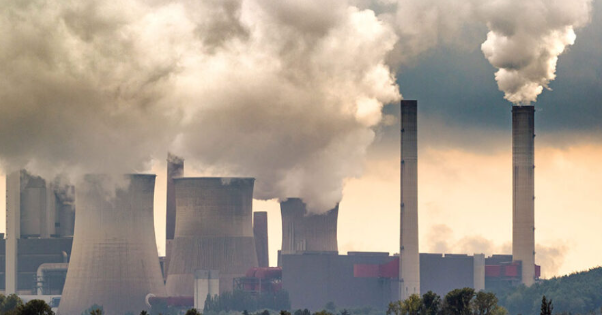
PVC cables contain halogens (like chlorine). When they burn, they release hydrogen chloride gas, which turns into hydrochloric acid when it hits moisture (like the water in a person’s lungs or eyes). This is lethal to humans and highly corrosive to the very electronic systems meant to manage the fire. BS 6724 cables use materials that produce less than 0.5% acid gas when burned.
The “Armoured” Advantage: Mechanical Protection
Public infrastructure is a “tough” environment. Cables are pulled through concrete ducts, buried in trenches, or exposed to potential accidental impact.
The Steel Wire Armour (SWA) in BS 6724 cables provides two major benefits:
- Mechanical Strength: It protects the internal cores from being crushed or severed during installation or through building shifts.
- Earthing: The armour can often serve as a Circuit Protective Conductor (CPC), provided it meets the necessary conductivity requirements for the specific installation.
Applications in Public Infrastructure
Where exactly should you be specifying BS 6724? The rule of thumb is: Wherever people congregate or expensive electronics are housed.
- Hospitals: Where patients may have limited mobility and need more time for evacuation.
- Underground Rail & Tunnels: Confined spaces where smoke accumulation is a rapid killer.
- Data Centers: Where acidic gases from standard cables could destroy millions of dollars in server hardware during a minor fire.
- Schools and Shopping Centers: High-density areas where clear exit paths are vital.
Why You Can’t Cut Corners
In the UK and international markets, E-E-A-T (Experience, Expertise, Authoritativeness, and Trustworthiness) isn’t just for Google—it’s for the engineers on the ground.
When you specify a cable for a public project, you are putting your professional reputation on the line. Using a BS 6724 cable that is BASEC (British Approvals Service for Cables) approved is the only way to ensure the product has been independently tested.
Pro Tip: Always check the sheath marking. A genuine BS 6724 cable will have the manufacturer’s name, the BS number, and the BASEC mark embossed clearly. If it’s missing, it’s a red flag.
Comparison: BS 6724 vs. BS 5467
Many contractors ask: “Can I just use BS 5467? It’s cheaper.” While both are armoured and use XLPE insulation, the difference lies entirely in the jacket.
| Feature | BS 5467 | BS 6724 |
| Insulation | XLPE | XLPE |
| Sheath Material | PVC (Polyvinyl Chloride) | LSZH (Low Smoke Zero Halogen) |
| Fire Performance | High smoke, toxic fumes | Low smoke, minimal fumes |
| Best For | Industrial/Outdoor use | Public buildings/Confined spaces |
| Cost | Lower | Slightly Higher |
While the initial cost of BS 6724 is higher, the “cost” of a failure in a public space is immeasurable. Most modern building regulations and insurance policies now mandate LSZH in public-facing projects.
Final Thoughts for Project Managers
Choosing BS 6724 LSZH Armoured Cables is about future-proofing. It’s about ensuring that if the worst happens, the building’s “nervous system” doesn’t become its most dangerous liability.
When you buy, look for quality, look for the BASEC mark, and never compromise on the LSZH specification for public safety.
