






IEC 60332 (Flame Retardant)-A Comprehensive Blog


Complete Guide to Flame Retardant Cable Standards
In modern electrical and industrial installations, fire safety is no longer optional—it is a critical design requirement. Electrical cables are often one of the primary contributors to fire spread in buildings, power plants, and industrial facilities. To address this risk, international standards have been developed to evaluate and limit the flame propagation characteristics of cables. One of the most widely recognized standards in this domain is IEC 60332, commonly associated with flame retardant cables.
This blog provides a comprehensive overview of IEC 60332, its classifications, testing methods, applications, and importance in ensuring electrical safety.
What is IEC 60332?
IEC 60332 is an International Electrotechnical Commission (IEC) standard that specifies test methods for assessing the flame propagation characteristics of electrical and optical fiber cables under defined conditions. In simple terms, it determines whether a cable can self-extinguish and limit the spread of fire when exposed to an open flame.
Cables that comply with IEC 60332 are commonly referred to as flame retardant (FR) cables, meaning they do not continue burning once the flame source is removed.
Why Flame Retardant Cables Matter
Electrical fires often spread rapidly through cable routes such as shafts, trays, ducts, and conduits. Ordinary cables can act as fuel, allowing flames to propagate vertically and horizontally. IEC 60332-compliant cables help to:
- Reduce fire spread
- Improve evacuation safety
- Protect equipment and infrastructure
- Comply with building and electrical safety regulations
- Minimize downtime and financial losses
Flame retardant performance is especially critical in high-occupancy and high-risk environments such as hospitals, airports, tunnels, data centers, and industrial plants.
Overview of IEC 60332 Classifications
IEC 60332 is not a single test but a series of tests, each designed for different cable configurations and installation scenarios.
1. IEC 60332-1 (Single Cable Flame Test)
IEC 60332-1 evaluates the flame retardancy of a single insulated cable or wire.
Key Features:
- Flame applied directly to a vertically mounted single cable
- Test duration depends on cable diameter
- After removal of the flame, the cable must self-extinguish
- Charred length must remain within specified limits
Applications:
- Building wiring
- Control cables
- Instrumentation cables
This is the most basic flame retardant requirement and is widely used for general electrical installations.
2. IEC 60332-2 (Small Cable Flame Test)
IEC 60332-2 is similar to Part 1 but applies to small-diameter cables and uses a different burner configuration.
- Suitable for flexible cords and smaller cables
- Less commonly referenced but still relevant for specific applications
3. IEC 60332-3 (Bunched Cable Flame Test)
IEC 60332-3 is the most critical and widely referenced part for industrial and commercial installations. It assesses flame propagation when multiple cables are bundled together, simulating real-world installations on cable trays or ladders.
IEC 60332-3 Categories:
IEC 60332-3 is subdivided into several categories based on flame severity:
- IEC 60332-3-A – Very high flame retardancy
- IEC 60332-3-B – High flame retardancy
- IEC 60332-3-C – Medium flame retardancy
- IEC 60332-3-D – Basic flame retardancy
Each category differs in:
- Flame intensity
- Duration of exposure
- Quantity of combustible material
Applications:
- Power plants
- Oil & gas facilities
- High-rise buildings
- Industrial cable trays
Flame Retardant vs Fire Resistant Cables
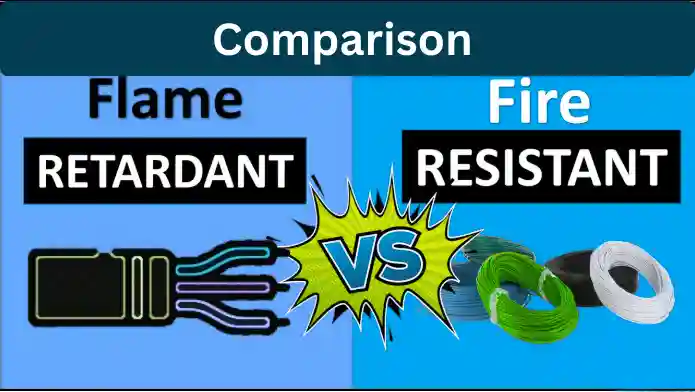
A common misconception is that flame retardant cables and fire resistant cables are the same. They are not.
| Feature | Flame Retardant (IEC 60332) | Fire Resistant |
|---|---|---|
| Purpose | Limits flame spread | Maintains circuit integrity |
| Fire Exposure | Stops burning after flame removal | Continues operating during fire |
| Typical Standards | IEC 60332 | IEC 60331 |
| Usage | General safety | Emergency systems |
IEC 60332 cables do not guarantee circuit operation during fire, but they significantly reduce fire propagation.
Materials Used in IEC 60332 Cables
Flame retardant performance is achieved through special insulation and sheath compounds, such as:
- Flame-retardant PVC
- FR-LS (Flame Retardant Low Smoke)
- FR-LSZH (Low Smoke Zero Halogen with FR properties)
- Cross-linked polyethylene (XLPE) with FR additives
These materials are engineered to:
- Release flame-quenching gases
- Form a protective char layer
- Reduce dripping of molten material
IEC 60332 vs LSZH Standards
IEC 60332 focuses only on flame propagation, not smoke or toxicity.
| Standard | Focus |
|---|---|
| IEC 60332 | Flame retardancy |
| IEC 61034 | Smoke density |
| IEC 60754 | Halogen acid gas emission |
For enhanced safety, cables are often designed to meet IEC 60332 along with LSZH standards, offering comprehensive fire protection.
Industries and Applications
IEC 60332 flame retardant cables are widely used in:
- Residential and commercial buildings
- Power generation and distribution
- Oil & gas facilities
- Railway and metro systems
- Data centers and telecom infrastructure
- Industrial automation systems
In many regions, compliance with IEC 60332 is mandatory under electrical codes and project specifications.
Benefits of IEC 60332-Compliant Cables
- ✔ Reduced fire spread
- ✔ Enhanced personnel safety
- ✔ Improved compliance with international standards
- ✔ Lower risk of secondary fire damage
- ✔ Suitable for modern high-density cable installations
Conclusion
IEC 60332 (Flame Retardant) is a cornerstone standard in electrical fire safety. By ensuring that cables do not propagate flames, it plays a vital role in protecting lives, infrastructure, and assets. Whether for residential wiring or complex industrial systems, choosing IEC 60332-certified flame retardant cables is a smart and responsible decision.
As electrical installations continue to grow in complexity and density, compliance with flame retardant standards like IEC 60332 is not just a recommendation—it is a necessity.
For such informative articles, click here Life Cables Blogs.