




High-Durability 3-Core Submersible Pump Cables for Deep Wells


The Ultimate Guide to 3-Core Submersible Pump Cables: Durability for Deep Well Reliability
If you’ve ever had a deep well pump fail in the middle of a hot season, you know the frustration isn’t just about the water—it’s about the labor and cost of pulling hundreds of feet of pipe and cable back to the surface. Often, the motor isn’t the problem; the silent culprit is a compromised cable.
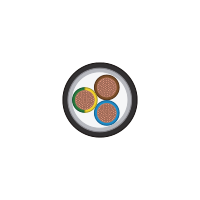
When dealing with deep well water motors, the cable is the lifeline. It operates in one of the most hostile environments imaginable: high pressure, constant moisture, temperature fluctuations, and potential mechanical abrasion. Choosing a high-durability 3-core submersible pump cable isn’t just a technical detail; it’s an insurance policy for your water supply.
Understanding the “Submersible” Challenge
Unlike standard electrical wiring, a submersible cable must maintain its insulation integrity while being permanently submerged. In deep wells, the “head” of water creates significant hydrostatic pressure. Standard PVC jackets can develop microscopic fissures over time, allowing moisture to reach the copper conductors, leading to short circuits or “nuisance tripping” of your breakers.
A 3-core configuration is the industry standard for single-phase motors requiring a ground or three-phase industrial motors. The quality of these three cores—and the jacket protecting them—determines whether your pump lasts five years or twenty.
Key Features of High-Durability Submersible Cables
To ensure long-term performance, look for cables that meet these specific engineering benchmarks:
1. Advanced Insulation Materials (XLPE vs. PVC)
While standard PVC is common, Cross-Linked Polyethylene (XLPE) is often the superior choice for deep wells. XLPE offers better thermal resistance and lower moisture absorption rates. However, high-grade, specially formulated “Submersible Grade PVC” is also highly effective if it is manufactured to withstand high pressure without deforming.
2. Robust Outer Sheathing
The outer jacket must be “tough-sheathed.” During installation, the cable is often taped or clipped to the drop pipe. As the pump starts and stops, the torque can cause the assembly to rub against the well casing. A high-durability cable features an abrasion-resistant outer layer that prevents the internal cores from being exposed.
3. Electrolytic Grade Copper
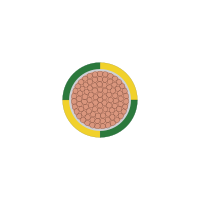
Conductivity is king. High-durability cables use 99.9% pure electrolytic grade bright annealed copper. This ensures minimal power loss (voltage drop) over long distances, which is crucial for deep wells where the cable run might exceed 300 feet.
Why E-E-A-T Matters in Cable Selection
When we talk about Experience, Expertise, Authoritativeness, and Trustworthiness (E-E-A-T) in the context of electrical components, we are looking at compliance and real-world testing.
- Experience: Field technicians know that a cable that feels “stiff” in cold weather is prone to cracking. A quality cable remains flexible, allowing for easier installation without compromising the jacket.
- Expertise: Look for cables that adhere to international standards such as IS 694 or IEC 60227. These certifications prove the cable has been tested for tensile strength and water immersion resistance.
- Authoritativeness: Top-tier manufacturers provide detailed data sheets including “Voltage Drop Tables.” This data is essential for calculating the correct gauge (AWG or $mm^2$) for your specific depth.
- Trustworthiness: A cable that is flame retardant (FR) and lead-free is not just better for the motor; it’s safer for the environment and the water table.
Preventing Voltage Drop in Deep Wells
One of the most common mistakes in deep well setups is undersizing the cable. Because the electricity has to travel a long distance down to the motor, resistance builds up, causing a drop in voltage.
If your motor receives $200V$ instead of the required $230V$, it will run hot. Heat is the enemy of motor windings. A high-durability cable with the correct cross-sectional area ensures that your motor stays cool and operates within its efficiency curve.
Pro Tip: Always calculate your cable size based on the “Total Dynamic Head” and the motor’s Full Load Amps (FLA). When in doubt, moving up one size in gauge is a small upfront cost compared to replacing a burnt-out motor.
Maintenance and Installation Best Practices
Even the best 3-core cable can fail if handled poorly. Follow these steps for a “humanistic” approach to a long-lasting system:
- The Waterproof Splice: Most leaks occur at the joint between the motor leads and the pump cable. Use a high-quality heat-shrink splicing kit with internal adhesive resin.
- Cable Ties: Use UV-resistant cable ties or specialized waterproof tape every 10 feet to secure the cable to the pipe. Leave a little “slack” between ties to allow for pipe expansion.
- Surge Protection: Deep wells act like lightning rods. Ensure your control box has adequate surge protection to prevent high-voltage spikes from traveling down the cable and blowing the insulation.
Conclusion: Investing in the “Invisible”
The pump cable is the most invisible part of your water system, buried hundreds of feet underground. However, it is the component that bridges the gap between your power supply and your water. By choosing a high-durability, 3-core submersible cable designed for deep well pressures, you are ensuring years of uninterrupted service.